Both blank verse and free verse leave out rhyme, but they differ in meter. Blank verse is unrhymed iambic pentameter: each line has about ten syllables in five unstressed-stressed beats. It was long the main form of English dramatic and epic poetry, used in Shakespeare’s plays and John Milton’s Paradise Lost.
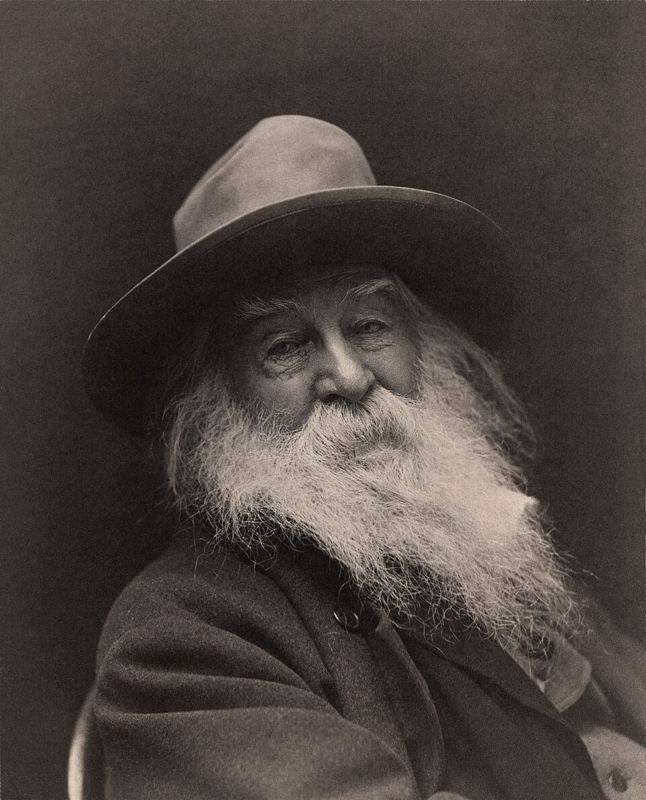
Free verse has no fixed meter at all. Its lines follow the natural rhythms of speech, and the poet does not follow a metrical plan, even if some patterns of sound appear. Walt Whitman and Matthew Arnold explored nonmetrical poetry in the 19th century, and since the early 20th century most published lyric poetry has been written in free verse. A quick test: if the unrhymed lines keep a steady ten-syllable, da-DUM rhythm, it is blank verse; if line length and rhythm vary freely, it is free verse.
Sources: Poetry Foundation: Blank verse and Poetry Foundation: Free verse
Image: Walt Whitman, photographed by George C. Cox (1887), public domain, via Wikimedia Commons.