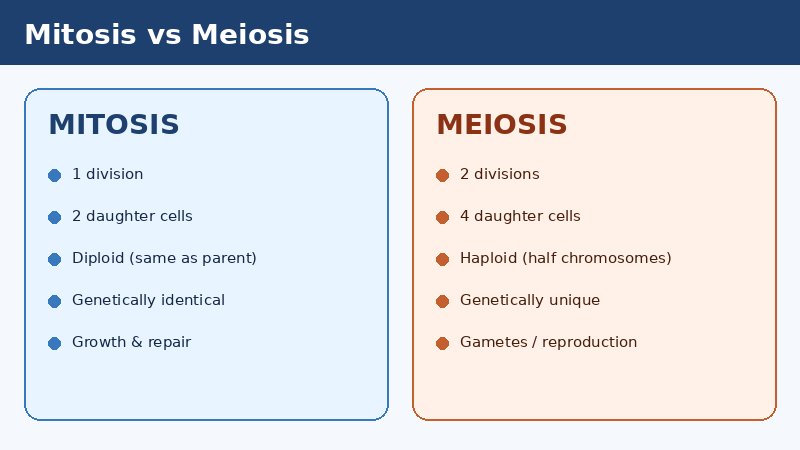
Mitosis and meiosis are both forms of nuclear division in eukaryotic cells, but they produce very different outcomes. Mitosis is a single division that yields two nuclei (usually two new cells) that are genetically identical to the parent and keep the same chromosome set count—typically diploid body cells used for growth, repair, and tissue maintenance.
Meiosis involves two successive divisions and produces four nuclei that are haploid (one chromosome set, half the diploid parent) and genetically distinct. In meiosis I, homologous chromosomes pair, can cross over, and then segregate, which reduces chromosome number; meiosis II then separates sister chromatids. Those haploid products become gametes for sexual reproduction.
Source: 26.5: Comparing Meiosis and Mitosis — Biology LibreTexts (OpenStax Biology).