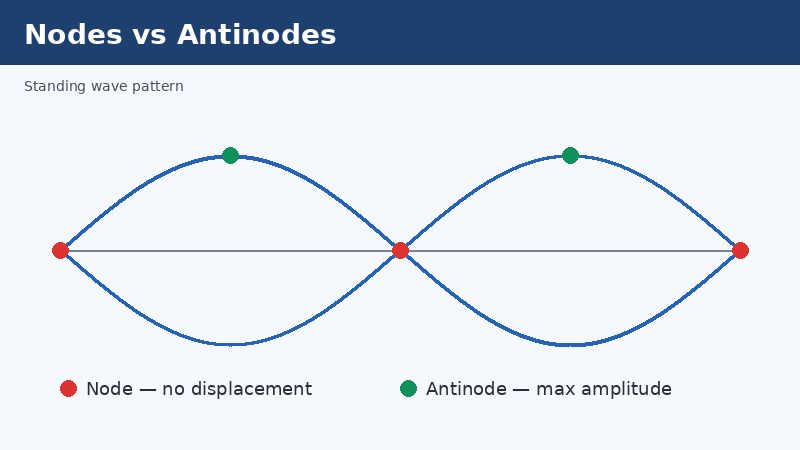
In a standing wave, a node is a fixed point along the medium where the displacement stays zero at all times, because overlapping waves cancel there (destructive interference). An antinode is a fixed point that oscillates with the largest amplitude, where the waves reinforce each other (constructive interference). Nodes and antinodes alternate and stay in place; that stationary interference pattern is what makes the wave “standing.”
OpenStax University Physics notes that for two identical waves traveling in opposite directions, nodes occur at integer multiples of half a wavelength, while antinodes occur at odd multiples of a quarter wavelength between those nodes. Musical strings are a common example: the fixed ends are nodes, and the vibrating loops between them are antinodes.
Source: OpenStax University Physics Volume 1 — Standing Waves and Resonance