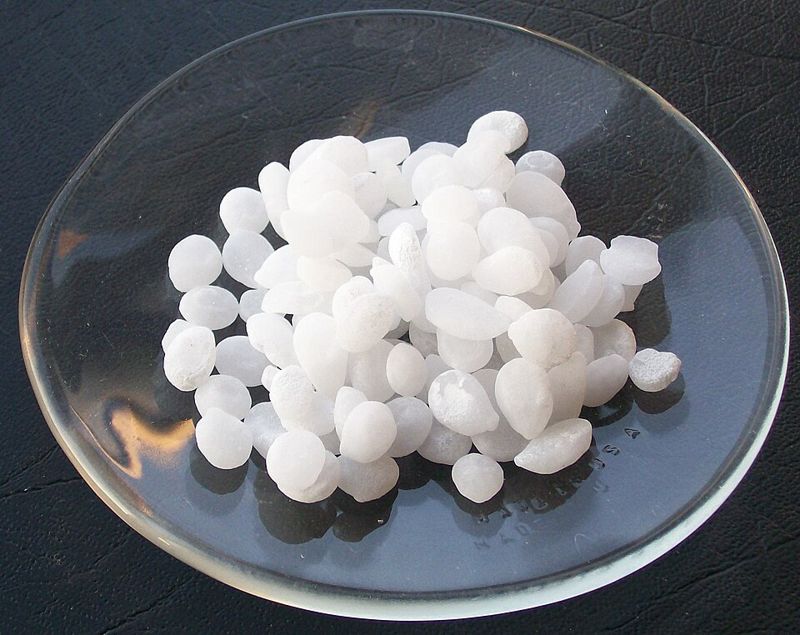
The difference is how completely the base turns into hydroxide ions (OH–) in water. A strong base, such as sodium hydroxide (NaOH) or potassium hydroxide (KOH), ionizes essentially 100% in solution, so each mole of sodium hydroxide gives a mole of hydroxide ions. Calcium hydroxide also counts as a strong base: it does not dissolve well, but whatever does dissolve is fully ionized.
A weak base only partly reacts with water in a reversible equilibrium. Ammonia (NH3) is the classic example: in solution, roughly 99% of it stays as ammonia molecules and only about 1% produces ammonium and hydroxide ions. Chemists compare weak bases with the base dissociation constant, Kb; the smaller Kb is, the weaker the base.
Source: Chemistry LibreTexts, Strong and Weak Bases
Image: Sodium hydroxide pellets by Walkerma, public domain, via Wikimedia Commons.