The gallium anomaly is a long-standing neutrino physics puzzle: experiments that fired electron neutrinos from radioactive sources into gallium detectors recorded about 20% fewer captures than theory predicted. In the capture reaction, an electron neutrino turns a gallium-71 nucleus into germanium-71 and releases an electron. The shortfall, first glimpsed in the 1990s, clearly stated in 2007 by physicist Carlo Giunti, and reaffirmed in 2022 by the BEST experiment at Baksan, was often cited as possible evidence for a hypothetical “sterile” neutrino, though that idea conflicted with other neutrino measurements.
In a study in Physical Review Letters reported on October 16, 2026, a team led by Matteo Cadeddu of Italy’s National Institute for Nuclear Physics (INFN) recalculated the reaction without treating the electron and the nuclear transition as independent pieces. Their new prediction agrees with the observed capture rate, suggesting the anomaly can be explained by standard physics without new particles.
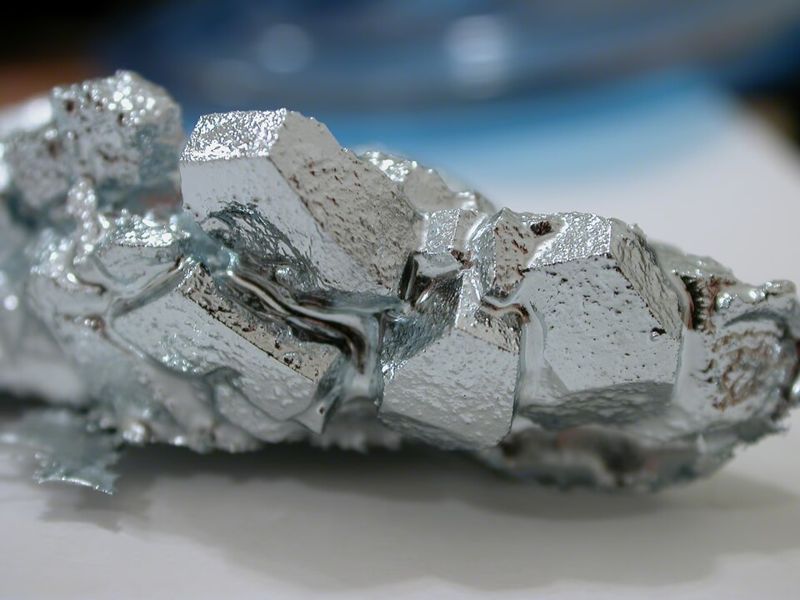
Image: Gallium crystals. en:user:foobar, CC BY-SA 3.0, via Wikimedia Commons.