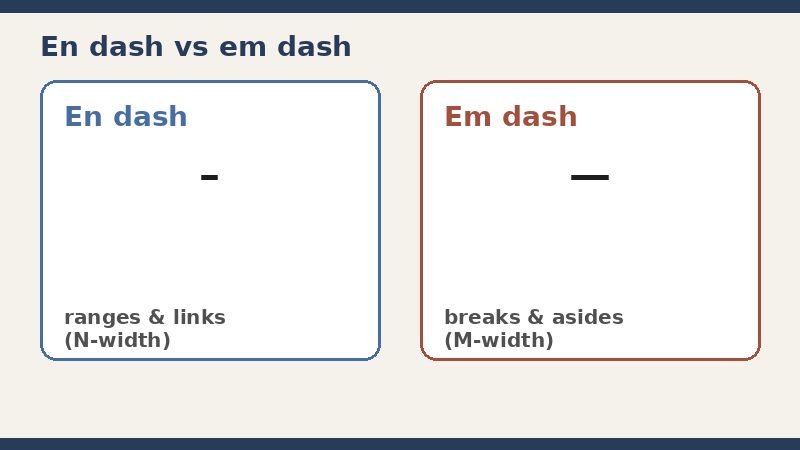
An en dash (–) is roughly the width of a capital N and most often marks inclusive ranges or links, such as dates, times, and page spans (for example, 2007–2019 or pages 128–34). Merriam-Webster also notes it can join compound adjectives when one part is itself multi-word, and can stand in for “to” between names or opposing ideas.
An em dash (—) is longer—about the width of a capital M—and works more like a comma, colon, or pair of parentheses: it sets off asides, marks abrupt breaks or interrupted speech, and can introduce amplifying material. In short, use the en dash for ranges and links, and the em dash for sentence-level breaks and emphasis.
Source: Merriam-Webster — How to Use Em Dashes, En Dashes, and Hyphens