
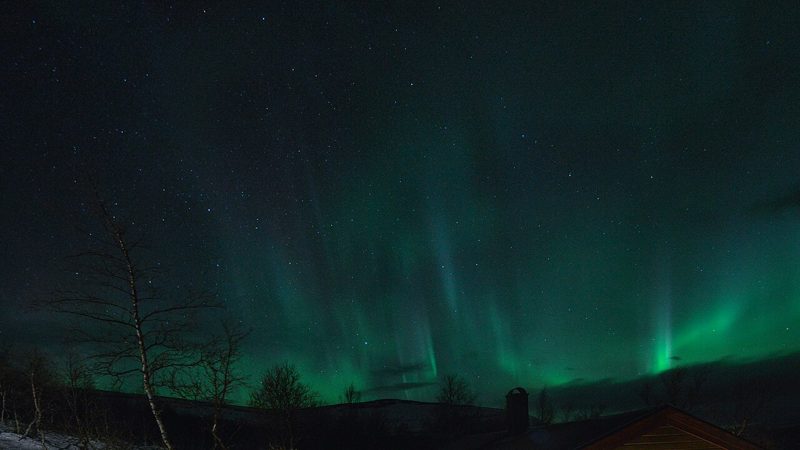
The northern lights are usually green because the most common auroral light comes from oxygen atoms high in the atmosphere, which give off pale green light at a wavelength of 557.7 nanometers when energized.
Aurora forms when electrons accelerated in Earth’s magnetosphere race down magnetic field lines at nearly one tenth the speed of light and strike atoms and molecules above about 100 km (60 miles). The collisions push the atoms into higher energy states, and they release light as they settle back down, much like gas in a neon sign. Green comes from oxygen excited to what physicists call the 1S state, which typically glows 120 to 400 km (80 to 250 miles) up. That state lasts only about one second, so it can emit light before collisions with other molecules knock the energy away, even in the relatively dense lower aurora. Oxygen can also glow deep red, but that state lasts more than 150 seconds and survives only above about 300 km, so red is less common. Nitrogen adds the purplish lower edge sometimes seen beneath the green.
Source: NOAA Space Weather Prediction Center, Aurora Tutorial
Image: Aurora borealis over Torkilstöten, Sweden, Arild Vågen, CC BY-SA 4.0, via Wikimedia Commons.