WASP-17b is a “hot Jupiter” about 1,300 light-years away: a gas giant that orbits so close to its star that one side stays in permanent daylight and the other in permanent night. Using NASA’s James Webb Space Telescope, researchers led by Cornell University and the University of Bristol found that its atmosphere is not a perfect circle. It extends farther outward on the planet’s “evening” side than on the cooler “morning” side.
The team used a new method called transmission strings (also called transit mapping). As the planet passes in front of its star, some starlight filters through the outer edge of the atmosphere (the limb). Instead of averaging that light into one spectrum, the technique measures how far the atmosphere reaches at different angles around the limb. That revealed a bulge near the equator on the evening side, where powerful winds carry hot gas from the dayside toward the nightside and make the atmosphere expand.
The result matches earlier models of hot-Jupiter weather and shows that exoplanet atmospheres can be mapped in three dimensions, not just as smooth rings. The study was published in Nature Astronomy.
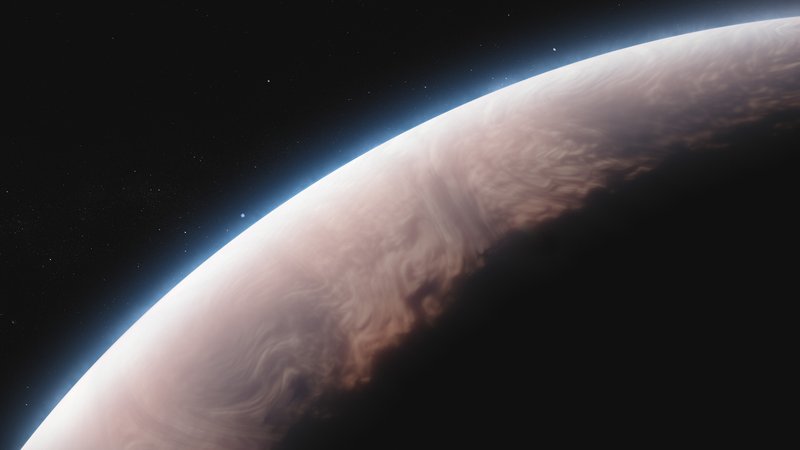
Image: Artist’s concept of exoplanet WASP-17 b. NASA, ESA, CSA, Ralf Crawford (STScI); public domain via Wikimedia Commons.