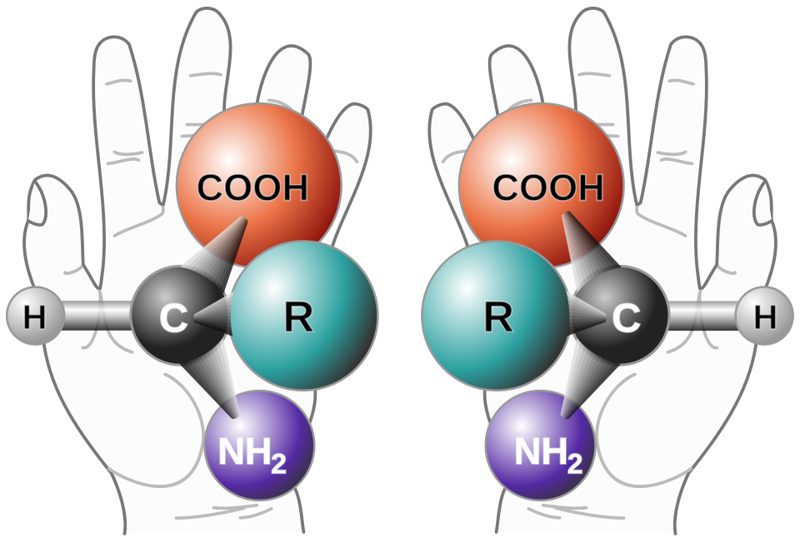
The 2026 Nobel Prize in Chemistry went to Henri B. Kagan of Université Paris-Sud in France and Kenso Soai of Tokyo University of Science in Japan, who share it equally. The Royal Swedish Academy of Sciences announced the award on Wednesday, October 7, 2026, “for the discovery of non-linear effects and autocatalysis in asymmetric organic synthesis.”
Their work explains how homochirality, life’s use of only one mirror-image form of molecules such as amino acids, can emerge in chemical reactions. Kagan showed in 1986 that reactions could produce a larger excess of one mirror image than chemists thought possible, and in 2003 Soai demonstrated a reaction that formed only one of the two possible mirror images. The Academy says these discoveries have been decisive for chemists who design reactions to make pharmaceuticals.
Source: NobelPrize.org, “Press release: Nobel Prize in Chemistry 2026” (October 7, 2026)
Image: Chirality illustrated with hands, public domain, via Wikimedia Commons.