
Last updated: November 11, 2026
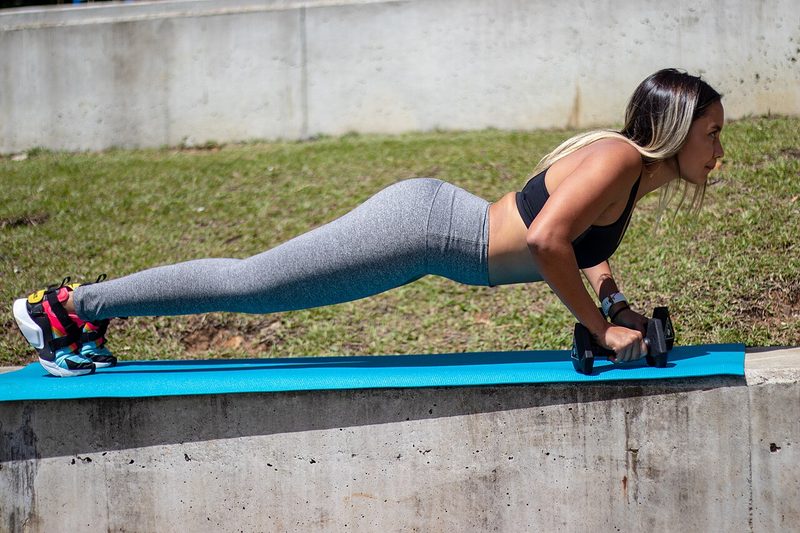
To learn how to do a push-up, start in a high plank with your hands slightly wider than your shoulders and your body straight from head to heels. Brace your core, bend your elbows to lower your chest toward the floor, then press back up until your arms are straight. That is one repetition.
Below: push-up form step by step, the muscles worked, common mistakes, easier and harder variations, and how many to do.
Contents
- How to do a push-up step by step
- What muscles do push-ups work?
- Common push-up form mistakes
- Push-ups for beginners: easier variations
- How to make push-ups harder
- How many push-ups should you do?
- Frequently asked questions
How to do a push-up step by step
The steps below combine the push-up instructions from the National Academy of Sports Medicine (NASM), the American Council on Exercise (ACE) and Harvard Health.
- Set your hands. Place your palms flat on the floor slightly wider than shoulder-width apart, with your shoulders directly over your hands and your fingers facing forward.
- Set your feet. Extend your legs behind you with your feet together or up to about 12 inches apart, resting on the balls of your feet.
- Brace your body. Tighten your abdominal, glute and thigh muscles so your body forms one straight line, and keep your head in line with your spine with your gaze down.
- Lower with control. Bend your elbows, keeping them about 45 degrees from your body, and take about two seconds to lower until your chest nearly touches the floor or your elbows reach about 90 degrees.
- Press back up. Push the floor away through your palms until your arms are straight again, keeping your hips level the whole time.
- Repeat. Do as many repetitions as you can while your body stays straight, then rest.
ACE notes that turning your hands forward and keeping your elbows close to your sides shifts more of the work from the chest to the triceps and may reduce stress on the shoulder joint (ACE).
What muscles do push-ups work?
Push-ups are a compound exercise, so several muscle groups work at once. NASM lists these muscles (NASM):
| Muscle | Role in the push-up |
|---|---|
| Pectoralis major (chest) | Primary mover; brings the arms toward the body as you press up |
| Triceps brachii (back of the upper arm) | Primary mover; straightens the elbows |
| Anterior deltoid (front shoulder) | Secondary; assists the press |
| Pectoralis minor and serratus anterior | Secondary; control the shoulder blades |
| Core stabilizers | Secondary; keep the body in a straight line |
Harvard Health adds that each push-up also strengthens the hips and legs (Harvard Health). Holding the rigid plank is an isometric effort, while the lowering and pressing are isotonic; see the difference between isometric and isotonic exercise.
Common push-up form mistakes
NASM identifies these common errors in push-up form (NASM):
- Sagging hips. A dropping lower back means the core has switched off and the exercise is less effective.
- Elbows flared wide. Pointing the elbows straight out increases shoulder stress and reduces chest work.
- Partial reps. Stopping well short of the floor limits the range of motion.
- Jerky movement. Bouncing or using momentum reduces muscle engagement.
- Leaning too far forward. This shifts the emphasis to the shoulders and triceps.
ACE also warns against letting the hips hike upward (ACE).
Push-ups for beginners: easier variations
A standard push-up lifts about 50% to 75% of your body weight, depending on your shape and size (Harvard Health). These easier variations reduce that load and the strain on your wrists and shoulders.
Wall push-ups
Stand facing a wall with your arms straight at chest height and palms flat on the wall. Bend your elbows to bring your upper body toward the wall, keeping a straight line from head to heel, then push back. Move your feet farther from the wall to make it harder (Harvard Health).
Incline push-ups
Place your hands on a sturdy raised surface such as a bench, then perform the push-up. NASM lists incline and knee push-ups as appropriate modifications for beginners (NASM). Lower surfaces are harder, so you can step down gradually.
Kneeling push-ups
Kneel on all fours with your hands shoulder-width apart, walk your hands forward until your arms are at about a 45-degree angle to your body, then lower until your elbows bend about 90 degrees and press back up (Harvard Health).
A simple progression plan
A step many guides leave out: change one thing at a time. Move from the wall to a counter, then a bench, then your knees, then a full push-up, advancing once your target reps feel solid with a straight body.
How to make push-ups harder
Once standard push-ups feel easy, Harvard Health suggests these progressions (Harvard Health):
- Tempo push-ups: take four seconds to lower until your chest nearly touches the floor, then push back up immediately.
- Uneven push-ups: place one hand on a yoga block or medicine ball, do half your reps, then switch sides.
- Elevated (decline) push-ups: put your feet on a step or chair seat to shift more body weight onto your chest and upper body.
- Shoulder tap push-ups: at the top of each rep, tap the opposite shoulder with one hand, then the other, before lowering.
How many push-ups should you do?
There is no “right” number of push-ups, according to Dr. Edward Phillips of Harvard Medical School. His advice is to do as many as possible with good form and to focus on progress, even one more than the week before (Harvard Health).
For overall health, the U.S. Physical Activity Guidelines say adults need muscle-strengthening activity, such as lifting weights or doing push-ups, at least 2 days each week, in addition to 150 to 300 minutes of moderate-intensity aerobic activity (health.gov). For aerobic goals, see how many steps a day you should walk and target heart rate by age.
What the research says about push-up capacity
A 10-year study of 1,104 male firefighters found that those who could complete more than 40 push-ups had a significantly lower risk of cardiovascular events than those who completed fewer than 10 (JAMA Network Open, 2019). The authors note it shows an association, not cause and effect, and that larger studies in more diverse groups are needed.
To build push-ups into a full plan, see these workout routines, and track body composition with our guide on how to calculate BMI. If you have an injury or health condition, ask a health professional before starting a new exercise.
Frequently asked questions
How many push-ups should I do a day?
There is no single right number. Harvard Health advises doing as many as you can with good form and aiming to add one more over time, and U.S. guidelines call for muscle-strengthening activity such as push-ups at least 2 days each week.
What muscles do push-ups work?
Push-ups mainly work the chest (pectoralis major) and the triceps. The front shoulders, serratus anterior and core muscles also work to support and stabilize the movement.
Why can’t I do a push-up?
A standard push-up lifts about 50% to 75% of your body weight, which is a heavy load for a beginner. Start with wall or kneeling push-ups and progress to a lower surface as you get stronger.
Do push-ups build muscle?
Yes. Harvard Health notes that each push-up strengthens the arm, shoulder and chest muscles as well as the core, hips and legs, and you can make them harder as you improve.
Are knee push-ups effective?
Yes. Kneeling push-ups use less body weight, so they let beginners build strength with good form before moving to the full version.
Sources
- National Academy of Sports Medicine: Push-Up
- Harvard Health Publishing: Modify your push-ups to meet your fitness level
- American Council on Exercise: Push-up
- health.gov: Top 10 Things to Know About the Physical Activity Guidelines
- Yang J, et al. Association Between Push-up Exercise Capacity and Future Cardiovascular Events Among Active Adult Men. JAMA Netw Open. 2019
Featured image: A woman holding a push-up position on a mat. Photo by PTPioneer (www.ptpioneer.com), CC BY 2.0, via Wikimedia Commons.
