
Last updated: November 14, 2026
To make eggnog, beat 6 eggs with sugar, stir in milk and cook the mixture over low heat, stirring constantly, until it reaches 160°F and coats a metal spoon. Cool it quickly in an ice-water bath, stir in the remaining milk or cream and vanilla, chill for several hours and serve with nutmeg.
This guide explains how to make eggnog at home with the cooked method recommended by the FDA, the ingredients and amounts, how to keep homemade eggnog safe, non-alcoholic and spiked options, and how long eggnog lasts in the fridge.
Contents
- Eggnog ingredients: what you need
- How to make eggnog step by step
- Is homemade eggnog safe? Raw eggs and the 160°F rule
- How to make eggnog non-alcoholic, spiked or lighter
- How long does eggnog last in the fridge?
- Frequently asked questions
Eggnog ingredients: what you need
Classic eggnog is a thin, drinkable custard. The two tested recipes below come from the U.S. Food and Drug Administration (FDA) and the American Egg Board (American Egg Board). The FDA version makes 2 quarts.
| Ingredient | FDA eggnog recipe | American Egg Board cooked eggnog |
|---|---|---|
| Eggs | 6 | 6 large |
| Sugar | 1/2 cup | 1/4 cup |
| Milk | 1 quart (4 cups) 2% milk | 4 cups whole milk, divided |
| Cream | 1 cup whipping cream, whipped | None |
| Vanilla | 1 teaspoon | 1 teaspoon |
| Salt | 1/4 teaspoon | None |
| Garnish | Ground nutmeg | Cinnamon sticks |
The FDA lists 135 calories per 1/2-cup serving for its version (FDA). Nutmeg is the signature spice; it is also one of the warm spices covered in our guide to what spices are in pumpkin spice. If you need to scale the recipe, our cooking conversion chart converts cups, quarts and teaspoons.
You will also need a heavy saucepan, a whisk, a large bowl of ice water and an instant-read food thermometer.
How to make eggnog step by step
This cooked method follows the FDA recipe, with timing tips from the American Egg Board (FDA; American Egg Board):
- Heat the milk. Warm the milk in a large saucepan until hot, but do not let it boil or scald.
- Beat the eggs. While the milk heats, beat the eggs and salt in a large bowl, adding the sugar gradually.
- Temper the eggs. Pour the hot milk into the eggs slowly, whisking the whole time, so the eggs warm gently instead of scrambling.
- Cook to 160°F. Return the mixture to the pan over medium-low heat and stir constantly until it thickens and just coats a spoon, and a food thermometer reads 160°F (71°C). The American Egg Board says this takes about 15 minutes over low heat.
- Add the vanilla. Take the pan off the heat and stir in the vanilla.
- Cool it fast. Set the pan in a bowl of ice or cold water and stir for about 10 minutes.
- Chill. Cover and refrigerate until thoroughly cold, several hours or overnight.
- Finish and serve. Pour into a bowl or pitcher, fold in the whipped cream and dust with ground nutmeg.
Why did my eggnog curdle?
Curdling happens when the eggs get too hot. Iowa State University Extension advises against letting the mixture go much beyond 160°F; if it does curdle, blend it until smooth and then chill it in ice water (Iowa State University Extension). The American Egg Board adds that low heat, a heavy pan, constant stirring and patience are the keys, because raising the heat to speed things up is likely to curdle the mixture (American Egg Board).
Is homemade eggnog safe? Raw eggs and the 160°F rule
Many old family recipes use raw eggs. Utah State University Extension warns that refrigerated eggs with clean, uncracked shells can still carry Salmonella, and that infants, young children, pregnant women, older adults and people with weakened immune systems face the highest risk (Utah State University Extension). Both the FDA and the USDA recommend starting with a cooked egg base (Iowa State University Extension).
You have three safe options:
- Cook the egg base to 160°F. This temperature kills Salmonella that may be present (Iowa State University Extension). It is the same reason we recommend a thermometer in our guide to chicken internal temperature.
- Use pasteurized eggs or egg products. Pasteurized shell eggs are sold next to regular eggs. Even so, Iowa State notes that the FDA and USDA still suggest starting with a cooked base for the best safety (Iowa State University Extension).
- Buy commercial eggnog. Store-bought eggnog is made with pasteurized eggs and does not need to be cooked (Utah State University Extension).
If a recipe calls for folding in raw, beaten egg whites, use pasteurized eggs, because raw whites have not been shown to be free of Salmonella (Utah State University Extension). For more on handling eggs, see how long eggs last in the fridge and our guide on how to boil eggs.
How to make eggnog non-alcoholic, spiked or lighter
The cooked recipe above is non-alcoholic, which makes it suitable for children and pregnant guests. To make spiked eggnog, stir rum, brandy or bourbon into the chilled base just before serving.
Does alcohol make eggnog safe?
No. Iowa State University Extension explains that alcohol in the amounts most recipes call for will not kill bacteria, so spiked eggnog still needs a cooked or pasteurized egg base (Iowa State University Extension).
Lighter eggnog
Utah State University Extension publishes a lower-fat version made with 5 cups of skim milk, 3/4 cup of sugar, 4 eggs or 1 cup of pasteurized egg product, a 12-ounce can of evaporated skim milk, 2 teaspoons of vanilla and an optional 1/4 teaspoon of rum extract. The base is cooked to 160°F, chilled 4 to 24 hours and then whisked into 1 pint of softened low-fat frozen vanilla yogurt (Utah State University Extension).
How long does eggnog last in the fridge?
Homemade eggnog has a short shelf life. These limits come from the federal cold food storage chart (FoodSafety.gov):
| Eggnog type | Refrigerator (40°F or below) | Freezer (0°F or below) |
|---|---|---|
| Homemade eggnog | 2 to 4 days | Do not freeze |
| Commercial eggnog | 3 to 5 days | 6 months |
Cool cooked eggnog quickly in an ice-water bath before refrigerating, as the FDA recipe directs (FDA). If you are planning a full holiday menu, our guide on how to cook a ham covers the main course.
Frequently asked questions
What is eggnog made of?
Eggnog is made of eggs, sugar, milk and usually cream, flavored with vanilla and nutmeg. The FDA’s version uses 6 eggs, 1/2 cup sugar, 1 quart of milk and 1 cup of whipping cream.
What temperature do you cook eggnog to?
Cook the egg and milk mixture to 160°F (71°C). At that temperature the mixture thickens enough to coat a metal spoon, and bacteria such as Salmonella are destroyed.
Is eggnog made with raw eggs?
Some traditional recipes use raw eggs, but food safety agencies recommend a cooked egg base or pasteurized eggs instead. Store-bought eggnog is made with pasteurized eggs and does not need to be cooked.
How long does homemade eggnog last?
Homemade eggnog keeps 2 to 4 days in a refrigerator at 40°F or below, according to FoodSafety.gov. Commercial eggnog keeps 3 to 5 days after opening.
Can you freeze eggnog?
FoodSafety.gov says commercial eggnog can be frozen for about 6 months, but homemade eggnog should not be frozen.
Does alcohol kill bacteria in eggnog?
Not reliably. Alcohol slows bacterial growth, but the amounts used in most recipes are not enough to kill bacteria, so cook the egg base or use pasteurized eggs even if you spike it.
Sources
- U.S. Food and Drug Administration: Holiday Goodies (Food Safety for Moms-to-Be)
- FoodSafety.gov: Cold Food Storage Chart
- Iowa State University Extension and Outreach: Homemade Eggnog Made Safe
- Utah State University Extension: Five Tips for Safe Holiday Eggnog
- American Egg Board: Classic Cooked Eggnog
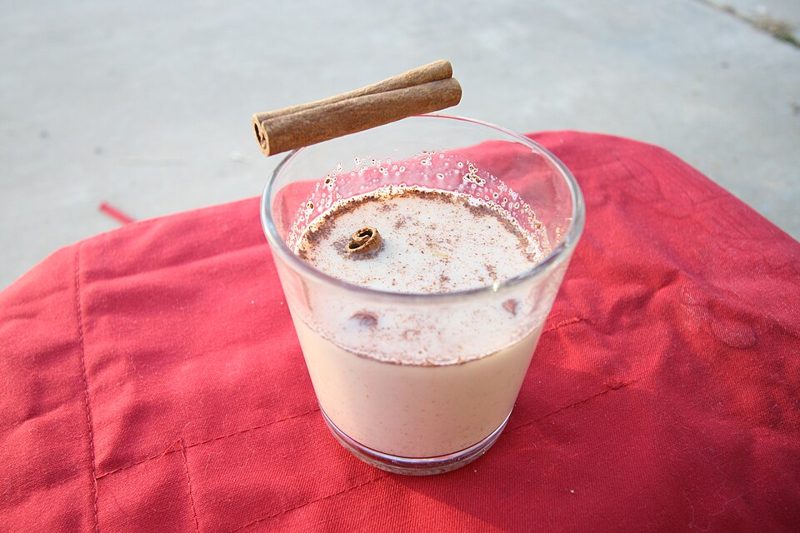
Featured image: Glass of eggnog with cinnamon. Credit: Wheeler Cowperthwaite, CC BY 2.0, via Wikimedia Commons; resized.
