
Last updated: November 25, 2026
How to make mulled wine: warm a 750 ml bottle of red wine in a large pan over low heat for about 10 minutes with a cinnamon stick, 2 star anise, 4 cloves, 2 strips of lemon zest and 4 tablespoons of sugar. Let it infuse for about 30 minutes, then reheat it without boiling and serve.
That is the classic method from BBC Good Food. This guide covers ingredients, the best wine, how much alcohol is left after heating, storage and reheating.
Contents
- What do you need to make mulled wine?
- How do you make mulled wine, step by step?
- What is the best wine for mulled wine?
- What spices go in mulled wine?
- Does mulled wine have alcohol?
- How long does mulled wine last, and can you reheat it?
- What is mulled wine called in other countries?
- Frequently asked questions
What do you need to make mulled wine?
The BBC Good Food classic recipe serves 6 and uses only six ingredients:
| Ingredient | Amount (serves 6) | Type |
|---|---|---|
| Red wine | 1 bottle (750 ml, about 25 fl oz) | Base |
| Cinnamon stick | 1 large or 2 small | Spice |
| Star anise | 2 | Spice |
| Whole cloves | 4 | Spice |
| Lemon zest | 2 strips, pared with a vegetable peeler | Citrus |
| Caster (superfine) sugar | 4 tablespoons | Sweetener |
The recipe lists about 196 calories per serving. To convert milliliters and spoons to cups, see our cooking conversion chart for cups, spoons and ounces.
How do you make mulled wine, step by step?
Follow these steps, based on the BBC Good Food method:
- Combine everything in a large pan. Add the wine, cinnamon, star anise, cloves, lemon zest and sugar.
- Heat gently. Cook on low heat for about 10 minutes.
- Infuse. Take the pan off the heat and let the wine stand for about 30 minutes so the spices flavor it.
- Reheat without boiling. Warm it again just before serving. If you want a stronger drink, BBC Good Food suggests stirring in 100 ml of sloe gin at this stage.
- Serve in heatproof glasses or mugs. Let it cool slightly first; it does not need to be served at boiling point.
Why should mulled wine not boil?
The recipe calls for heating without boiling, and higher heat for longer drives off more of the alcohol (see the USDA figures below). Scandinavian glögg, for example, is heated to 60–70 °C (140–158 °F), well below boiling, according to Wikipedia.
What is the best wine for mulled wine?
You do not need an expensive bottle. BBC Good Food says any good-quality red wine works and suggests an unoaked tempranillo. You can also mull rosé or white wine.
Older recipes used fortified and French wines: the 1869 edition of Mrs. Beeton’s Book of Household Management says any wine may be mulled, but port and claret were the usual choices, as quoted on Wikipedia. In the European Union, a drink sold as Glühwein must be made only from red or white wine, with no added water, under Regulation (EU) No 251/2014. A white-wine version must say so on the label.
What spices go in mulled wine?
There is no single fixed recipe. According to Wikipedia, common combinations include:
- British style: orange, lemon, cinnamon, nutmeg, fennel seed or star anise, cloves, cardamom and ginger, sometimes with brandy or ginger wine.
- German Glühwein: cinnamon sticks, cloves, star anise, orange, sugar and sometimes vanilla. EU rules require Glühwein to be flavored mainly with cinnamon and/or cloves and to have at least 7% alcohol by volume (EUR-Lex).
- Nordic glögg: red wine with cinnamon, cardamom, ginger, cloves and bitter orange, often served with raisins and blanched almonds.
- Polish grzaniec: similar to Glühwein but usually sweetened with honey instead of sugar.
For another traditional winter treat, see how to roast chestnuts in the oven or over a fire.
Does mulled wine have alcohol?
Yes. Heating removes some alcohol, but far less than many people assume. The USDA Table of Nutrient Retention Factors lists how much alcohol remains after common cooking methods:
| Preparation method | Alcohol remaining |
|---|---|
| Stirred into a hot liquid and removed from heat | 85% |
| Flamed | 75% |
| Stirred in, then baked or simmered 15 minutes | 40% |
| Simmered 30 minutes | 35% |
| Simmered 1 hour | 25% |
| Simmered 2 hours | 10% |
| Simmered 2.5 hours | 5% |
For scale, the National Institute on Alcohol Abuse and Alcoholism defines one U.S. standard drink as about 14 grams of pure alcohol, the amount in a 5-ounce glass of wine at 12% alcohol. A 750 ml bottle holds about 25 ounces, or roughly five standard drinks at that strength before heating. Spirits such as rum or brandy, which are common additions, raise the total.
How do you make non-alcoholic mulled wine?
Because even long simmering leaves some alcohol, the reliable option is to start without wine. Wikipedia notes that mulled apple juice is the usual alcohol-free choice in the United Kingdom, German Christmas markets serve a spiced punch called Kinderpunsch, and glögg can be made with blackcurrant or other fruit juices. For a related question, see whether apple cider contains alcohol.
How long does mulled wine last, and can you reheat it?
BBC Good Food advises keeping leftover mulled wine in the fridge for up to 24 hours. It may keep a day longer, but if it contains fruit, do not keep it beyond 24 hours, because it may start to ferment.
To reheat it:
- Stovetop: warm it over low heat.
- Microwave: pour it into a heatproof bowl and heat for 2 minutes 30 seconds to 3 minutes, until warm but not boiling.
Planning a holiday drinks table? Our guide on how to make eggnog with a safe cooked recipe covers another seasonal favorite.
What is mulled wine called in other countries?
Spiced, heated wine has a long history. The earliest record appears in the Roman playwright Plautus’s play Curculio from the 2nd century BC, and an English cookbook from 1390, The Forme of Cury, describes a spiced wine called ypocras (Wikipedia). Regional names include:
- Glühwein in German-speaking countries and Alsace, roughly “glowing wine”
- Glögg, gløgg or glögi in the Nordic countries and Estonia
- Vin chaud (“hot wine”) in France
- Svařené víno in the Czech Republic and varené víno in Slovakia (“boiled wine”)
- Vinho quente or quentão in southern Brazil, served at the June festivals
Hosting a gathering this season? See our white elephant gift exchange rules.
Frequently asked questions
What is mulled wine made of?
Mulled wine is usually red wine heated with spices such as cinnamon, cloves and star anise, plus citrus and sugar or honey. Some versions add brandy, rum or another spirit.
What wine is best for mulled wine?
Any good-quality red wine works. BBC Good Food suggests an unoaked tempranillo, and white or rosé wine can also be mulled.
Does mulled wine have alcohol?
Yes. Heating removes only part of the alcohol: USDA tests found that about 85% remained when alcohol was stirred into a hot liquid, and about 40% remained after 15 minutes of simmering.
Can you reheat mulled wine?
Yes. Warm it over low heat on the stove, or microwave it in a heatproof bowl for about 2 minutes 30 seconds to 3 minutes until warm, but do not let it boil.
How long does mulled wine last in the fridge?
BBC Good Food advises keeping leftover mulled wine in the fridge for up to 24 hours. If it contains fruit, do not keep it longer than that, because it may start to ferment.
What is mulled wine called in German?
In German it is called Glühwein, which roughly means glowing wine. It is a traditional drink at Christmas markets in German-speaking countries.
Please drink responsibly. Mulled wine still contains alcohol after heating.
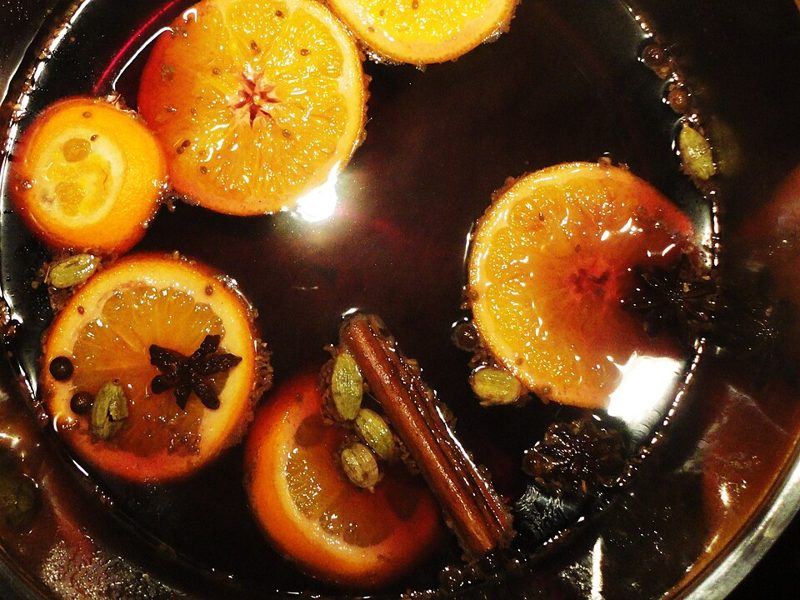
Featured image: “Glühwein-Zubereitung” by Angela Huster, CC0, via Wikimedia Commons; resized.

Sources
- BBC Good Food: Classic mulled wine
- USDA Agricultural Research Service: Table of Nutrient Retention Factors, Release 6 (PDF)
- National Institute on Alcohol Abuse and Alcoholism: What is a standard drink?
- EUR-Lex: Regulation (EU) No 251/2014 on aromatised wine products
- Wikipedia: Mulled wine