
Last updated: November 14, 2026
The Geminid meteor shower peaks on the night of December 13 to 14, 2026, and is active from about December 4 to December 17. Under dark skies you can expect 40 to 50 meteors per hour, and a thin crescent Moon means 2026 viewing conditions are favorable. Start watching around 9 or 10 p.m.
This guide covers the Geminid meteor shower time and peak date for 2026, the Moon phase, meteors per hour, the best time to see the Geminids and where to look. Figures come from NASA, the American Meteor Society (AMS) and the International Meteor Organization (IMO).
Contents
- When is the Geminid meteor shower in 2026?
- How many Geminid meteors per hour can you see?
- What is the best time to see the Geminids?
- How to watch the Geminid meteor shower
- Where to look: the Geminid radiant
- What causes the Geminid meteor shower?
- Frequently asked questions
When is the Geminid meteor shower in 2026?
NASA lists the Geminids as active from December 4 to December 17, 2026, with the peak on December 13 to 14 (NASA). The IMO’s 2026 calendar gives a slightly longer window, December 4 to 20, and places the maximum at 14:00 Universal Time on December 14 (IMO). That is 9 a.m. Eastern and 6 a.m. Pacific time, but the maximum is broad, so the night before is the one to plan for.
| Item | Geminids 2026 |
|---|---|
| Active period | December 4 to 17 (NASA, AMS); December 4 to 20 (IMO) |
| Peak night | December 13 to 14 |
| Predicted maximum | December 14, 14:00 UT (IMO) |
| Moon on peak night | Waxing crescent, about 15% illuminated (AMS) |
| Expected rate, dark skies | 40 to 50 meteors per hour (NASA) |
| Zenithal hourly rate (ZHR) | 150 (IMO) |
| Meteor speed | 22 miles (35 kilometers) per second |
| Radiant | Constellation Gemini |
| Parent body | Asteroid 3200 Phaethon |
What phase is the Moon during the 2026 Geminids?
The Moon will be a waxing crescent, about 15% illuminated, on peak night, which the AMS describes as generally favorable with limited moonlight interference (AMS). The IMO calls the 2026 maximum “moon-free.” In the UK, the Royal Observatory Greenwich says the Moon sets around 9:20 p.m., leaving dark skies for the rest of the night (Royal Observatory Greenwich).
How many Geminid meteors per hour can you see?
NASA says to expect 40 to 50 meteors per hour under dark skies, and up to 120 per hour in perfect conditions (NASA). The AMS notes that Geminid rates usually pass 60 to 70 per hour at maximum (AMS).
You may also see the IMO figure of a ZHR of 150 (IMO). The zenithal hourly rate is a standardized number: how many meteors one observer would see with the radiant directly overhead under a perfectly dark sky. Real counts are lower because of light pollution and a lower radiant.
What is the best time to see the Geminids?
The Geminids are unusual because they put on a good show before midnight. The AMS says the constellation Gemini is well placed from 10 p.m. onward (AMS), and NASA notes the shower starts around 9 or 10 p.m. and lasts until dawn, which makes it one of the best meteor showers for children (NASA).
Rates climb as the radiant rises higher. The IMO says the radiant culminates, or reaches its highest point, near 2 a.m. local time (IMO), so the hours around 2 a.m. usually give the most meteors. If you cannot stay up late, the nights of December 12 to 13 and December 14 to 15 still show good activity.
The Geminids fall about a week before the winter solstice, when nights are at their longest in the Northern Hemisphere, so you have many hours of darkness to work with.
How to watch the Geminid meteor shower
You do not need any equipment. Follow these steps, based on NASA and Royal Observatory Greenwich advice (NASA; Royal Observatory Greenwich):
- Check the forecast. Pick the clearest night between December 12 and 15, ideally December 13 to 14.
- Get away from lights. Find a safe, open spot well away from city lights and street lights, with a wide view of the sky.
- Dress for winter. Bring warm layers, a blanket or sleeping bag and a reclining lawn chair.
- Lie back and look up. Lie flat with your feet facing south and take in as much of the sky as possible.
- Let your eyes adapt. Give it about 30 minutes in the dark and avoid looking at your phone screen.
- Be patient. The show lasts until dawn.
Leave the binoculars and telescope at home; they show only a small patch of sky. If you are driving to a dark-sky site on icy roads, review our tips on how to drive in snow first.
Where to look: the Geminid radiant
The radiant, the point the meteors appear to come from, is in the constellation Gemini, which gives the shower its name. NASA stresses that you should not look only toward Gemini, because Geminid meteors appear all over the sky (NASA). The Royal Observatory Greenwich suggests looking slightly away from the radiant into a dark part of the sky (Royal Observatory Greenwich).
Can you see the Geminids from anywhere in the world?
NASA says the Geminids are visible across the globe thanks to a nearly 24-hour broad maximum. Middle and northern latitudes are best, because the radiant rises around sunset. In the Southern Hemisphere, the radiant appears only around local midnight and rates are lower (IMO).
What causes the Geminid meteor shower?
Unlike most showers, which come from comets, the Geminids come from 3200 Phaethon, a small object about 3.17 miles (5.10 kilometers) across that may be an asteroid, a “dead comet” or a “rock comet.” It orbits the Sun every 1.4 years. Each December, Earth passes through the debris it left behind, and the particles burn up in the atmosphere as meteors (NASA).
The Geminids are also relatively young. They first appeared in the mid-1800s with only 10 to 20 meteors per hour and have since grown into one of the strongest showers of the year (NASA). For other showers on the calendar, see when the Orionid meteor shower, the Draconid meteor shower and the Taurid meteor showers peak.
Frequently asked questions
What time is the Geminid meteor shower?
The Geminids are visible from about 9 or 10 p.m. local time until dawn. The International Meteor Organization puts the 2026 maximum at 14:00 UT on December 14, but the peak is broad, so the night of December 13 to 14 is the best time to watch.
Can you see the Geminid meteor shower without a telescope?
Yes. Meteors are best seen with the naked eye, because a telescope or binoculars show only a tiny part of the sky. All you need is a dark location and about 30 minutes for your eyes to adapt.
What direction should I look for the Geminid meteor shower?
Geminid meteors appear all over the sky, not only near the constellation Gemini. NASA suggests lying on your back with your feet facing south and looking up to take in as much sky as possible.
How many meteors per hour can you see during the Geminids?
NASA says to expect about 40 to 50 meteors per hour under dark skies, with up to 120 per hour in perfect conditions. Light pollution, moonlight and clouds lower the number you will actually see.
What causes the Geminid meteor shower?
The Geminids come from debris shed by 3200 Phaethon, a small asteroid or possible “rock comet,” rather than an icy comet. Each December, Earth passes through this debris trail and the particles burn up in the atmosphere.
Sources
- NASA Science: Geminids Meteor Shower
- International Meteor Organization: 2026 Meteor Shower Calendar (PDF)
- American Meteor Society: Meteor Shower Calendar
- American Meteor Society: Major Meteor Showers
- Royal Observatory Greenwich: Geminid meteor shower 2026
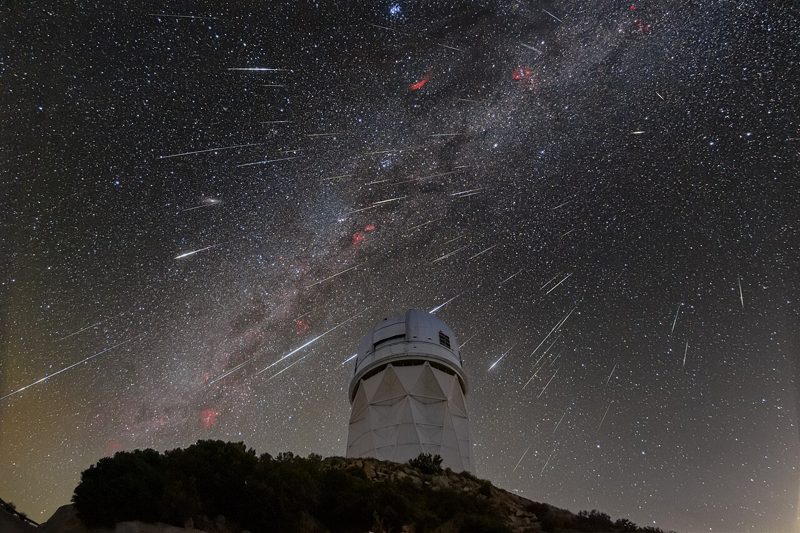
Featured image: Geminid meteors streak over the Nicholas U. Mayall Telescope at Kitt Peak National Observatory. Credit: KPNO/NOIRLab/NSF/AURA/R. Sparks, CC BY 4.0, via Wikimedia Commons; resized.
