
Last updated: November 9, 2026
To drive in snow safely, slow down, accelerate and brake gently, and increase your following distance to five to six seconds, as AAA recommends. Skip cruise control, avoid stopping on hills, and if you have antilock brakes, press firmly and steadily instead of pumping the pedal.
This guide covers how to drive in snow and ice step by step, from preparing your car to what to do if you get stuck.
Contents
- Why is driving in snow dangerous?
- How to drive in snow: step by step
- How to brake on snow and ice
- How to drive up and down hills in snow
- Driving in snow vs. dry roads at a glance
- How to prepare your car for winter driving
- What to keep in your car in winter
- What to do if you get stuck in the snow
- Frequently asked questions
Why is driving in snow dangerous?
Snow and ice cut tire traction, so your car takes longer to stop and is harder to steer. NHTSA reports that in 2024 an estimated 131,698 police-reported crashes happened during snow or sleet, including 365 fatal crashes and an estimated 24,383 injury crashes (NHTSA).
The Federal Highway Administration estimates that freezing precipitation (snow, sleet, hail and freezing rain) is present in about 219,942 crashes a year, based on 2019–2023 averages, and that heavy snow can lower average freeway speeds by 5% to 40% (FHWA). Shorter days add to the risk: after daylight saving time ends, more evening commutes happen in the dark, and the winter solstice brings the shortest day of the year.
How to drive in snow: step by step
- Decide whether you need to go. AAA advises staying home unless the trip is necessary, and Ready.gov says to stay off roads if at all possible during winter storms (AAA; Ready.gov).
- Check the weather and route. Check weather and traffic reports, review directions, and tell someone your route and arrival time (NHTSA).
- Clear the car and warm it up outdoors. Never warm up a vehicle in an enclosed area such as a garage (AAA).
- Slow down. Adjust your speed down to account for lower traction on snow or ice (AAA).
- Accelerate and decelerate gently. Apply the gas slowly to regain traction and avoid skids, and start slowing earlier for lights and stop signs (AAA).
- Leave five to six seconds of following distance. That extra margin gives you the longer distance you need to stop (AAA).
- Turn off cruise control. Do not use it on any slippery surface (AAA).
- Give snowplows room. Plows travel slowly, make wide turns, stop often and overlap lanes, so stay well behind them and use caution if you pass (NHTSA).
How to brake on snow and ice
First, know which brake system your car has; the owner’s manual will say. NHTSA’s guidance is simple (NHTSA):
- Antilock brakes (ABS): apply firm, continuous pressure to the brake pedal. Do not pump.
- No antilock brakes: pump the brakes if you feel the wheels starting to lock.
AAA adds a technique that works with either system: keep the heel of your foot on the floor and use the ball of your foot to apply firm, steady pressure (AAA). If you can slow down enough to keep rolling until a traffic light changes, do that instead of stopping, because getting moving again from a full stop takes much more traction.
How to drive up and down hills in snow
- Build momentum first. Get some speed on a flat stretch before the hill and let that carry you up. Extra gas on a snowy hill just spins the wheels (AAA).
- Don’t stop going uphill. Starting again on an icy incline is very difficult.
- Go down slowly. Reduce speed as you reach the crest and descend slowly.
Driving in snow vs. dry roads at a glance
| Habit | Dry pavement | Snow and ice |
|---|---|---|
| Following distance | Normal | 5–6 seconds (AAA) |
| Speed | Posted limit | Well below the limit, matched to traction |
| Acceleration and braking | Normal | Slow, gentle and early |
| Cruise control | OK | Off |
| Braking with ABS | Normal | Firm, continuous pressure (NHTSA) |
| Fuel | Any level | At least half a tank (AAA) |
How to prepare your car for winter driving
Tires
Tire pressure drops as the temperature falls. Inflate to the pressure on the driver’s door-frame label or in the owner’s manual, not the maximum printed on the tire, and make sure tread is at least 2/32 of an inch. In the penny test, if you can see the top of Lincoln’s head, you need new tires (NHTSA). Our guide on how to check tire pressure walks through it, and NHTSA suggests considering snow tires.
Battery
Cold weather reduces battery power, and gasoline and diesel engines need more battery power to start, while electric vehicles can lose range (NHTSA). Have the battery checked, and learn how to jump-start a car in case it dies.
Wipers, lights and coolant
Fill the reservoir with winter washer fluid with de-icer, replace worn wiper blades, test the defrosters, check all lights, and confirm coolant meets the manufacturer’s specifications (NHTSA).
What to keep in your car in winter
- Snow shovel, broom or snow brush, and ice scraper
- Sand, salt, non-clumping cat litter or traction mats
- Jumper cables, flashlight with extra batteries, and flares or warning triangles
- First aid kit and any needed medicines
- Blankets, gloves, hats and extra warm clothing
- Bottled water and non-perishable food
- Cell phone and car charger
This list combines the NHTSA and AAA recommendations (NHTSA; AAA). Keep your gas tank close to full, and keep an electric vehicle charged, plugging it in overnight when you can (NHTSA).
What to do if you get stuck in the snow
- Stay with your vehicle. It provides shelter and helps rescuers find you. Do not walk in a severe storm (AAA).
- Don’t overexert yourself digging or pushing the car out.
- Make the car visible. Tie a bright cloth to the antenna or a window, and keep the dome light on at night.
- Clear the exhaust pipe. A blocked exhaust can let deadly carbon monoxide into the car (NHTSA).
- Run the engine only in short spells, just long enough to stay warm and conserve fuel.
Ready.gov notes that winter storms also raise the risk of hypothermia and frostbite, so insulate yourself with anything available (Ready.gov). Before you leave home for a long trip, it is also worth taking steps to prevent frozen pipes.
Frequently asked questions
What is the best way to drive in snow?
Slow down, accelerate and brake gently, and leave five to six seconds between you and the car ahead. AAA also advises staying home unless the trip is necessary.
How far behind should you follow in snow?
AAA recommends a following distance of five to six seconds on snow and ice, which gives you the extra distance you need to stop.
Should you pump the brakes in snow?
Only if your car does not have antilock brakes. With antilock brakes, NHTSA says to apply firm, continuous pressure; without them, pump the brakes if the wheels start to lock.
Should you use cruise control in snow?
No. AAA advises against using cruise control on any slippery surface, including snow and ice.
What should you keep in your car in winter?
Carry a shovel, ice scraper, sand or cat litter for traction, jumper cables, a flashlight, a first aid kit, blankets, water, snacks and a phone charger, as NHTSA and AAA recommend.
What should you do if you get stuck in snow in your car?
Stay with your vehicle, make it visible with a bright cloth and the dome light, keep the exhaust pipe clear of snow, and run the engine only long enough to stay warm.
Sources
- NHTSA — Winter Weather Driving Tips
- AAA Exchange — Winter Driving Tips
- FHWA Road Weather Management — How Do Weather Events Affect Roads?
- Ready.gov — Winter Weather
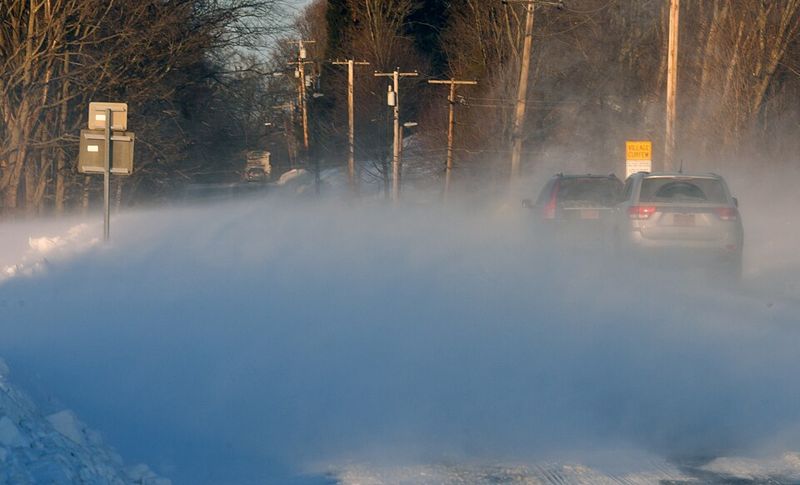
Featured image: cars driving through blowing snow on NY 211 outside Montgomery, New York. Photo by Daniel Case, CC BY-SA 3.0, via Wikimedia Commons.
