
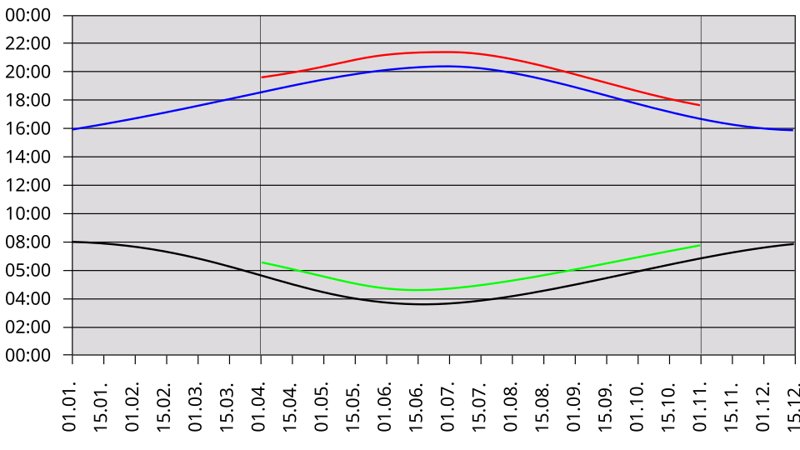
Last updated: November 3, 2026
Daylight saving time (DST) is the part of the year when clocks are set one hour ahead of standard time. In the United States it starts at 2:00 a.m. local time on the second Sunday of March and ends at 2:00 a.m. on the first Sunday of November. The next change is Sunday, March 14, 2027.
Contents
- What is daylight saving time?
- When does daylight saving time start and end?
- How to change your clocks for daylight saving time
- Which states do not observe daylight saving time?
- Why do we have daylight saving time?
- Is daylight saving time becoming permanent?
- Daylight saving time in the UK
- Frequently asked questions
What is daylight saving time?
The National Institute of Standards and Technology (NIST) defines daylight saving time as the period of the year when clocks are moved one hour ahead. Moving the clock forward shifts one hour of daylight from the morning to the evening, which gives more sunlit hours after work during the warmer months.
The memory aid is “spring forward, fall back.” Clocks move ahead one hour in spring and back one hour in fall, when the country returns to standard time. It is often called “daylight savings time,” but the official name has no final “s.”
When does daylight saving time start and end?
Federal law, 15 U.S.C. § 260a, sets the dates for the whole country. Daylight saving time begins at 2:00 a.m. on the second Sunday of March and ends at 2:00 a.m. on the first Sunday of November, in each time zone’s local time.
| Year | Daylight saving time starts (clocks forward) | Daylight saving time ends (clocks back) |
|---|---|---|
| 2026 | Sunday, March 8 | Sunday, November 1 |
| 2027 | Sunday, March 14 | Sunday, November 7 |
| 2028 | Sunday, March 12 | Sunday, November 5 |
| 2029 | Sunday, March 11 | Sunday, November 4 |
| 2030 | Sunday, March 10 | Sunday, November 3 |
| 2031 | Sunday, March 9 | Sunday, November 2 |
In 2026, NIST confirms daylight saving time ran from March 8 to November 1. The later dates in the table apply the same legal rule. In 2027, daylight saving time lasts 238 days, which matches the roughly 238 days, or about 65% of the year, that NIST gives for the current schedule.
What happens at 2 a.m.?
- In March: at 2:00 a.m. the local time skips ahead to 3:00 a.m. The day has 23 hours, so you lose an hour of sleep.
- In November: at 2:00 a.m. the local time becomes 1:00 a.m. again and that hour repeats. The day has 25 hours, so you gain an hour.
For this year’s fall change in detail, see when daylight saving time ends in 2026.
How to change your clocks for daylight saving time
Phones and computers usually update on their own. Use this checklist for everything else:
- Check that your phone and computer have the latest operating system updates. NIST notes that internet time services send Coordinated Universal Time (UTC), and your operating system applies the DST correction.
- Before bed on Saturday night, set manual clocks (oven, microwave, car, wall clocks) one hour ahead in March or one hour back in November.
- Check radio-controlled clocks the next morning. They should switch automatically from the WWVB signal, but NIST says to make sure the clock has received the signal recently.
- If you live where DST is not observed, such as most of Arizona, turn off the automatic DST setting on clocks that have one.
Which states do not observe daylight saving time?
Most of the country observes daylight saving time. According to NIST, it is not observed in:
- Hawaii
- Arizona, except the Navajo Indian Reservation, which does observe DST
- American Samoa
- Guam
- Puerto Rico
- The U.S. Virgin Islands
These places stay on standard time all year. Read more about which states do not observe daylight saving time and why Arizona does not observe daylight saving time. For the bigger picture, see how many time zones are in the U.S.
Why do we have daylight saving time?
Daylight saving time was formally introduced in the United States in 1918, according to NIST. The current federal framework dates to the Uniform Time Act of 1966, and Congress has changed the dates several times since, as recorded in the amendment notes to 15 U.S.C. § 260a:
| Year enacted | Change |
|---|---|
| 1966 | The Uniform Time Act set a national daylight saving period and let states exempt themselves |
| 1972 | States split across two time zones could exempt only the part in one zone |
| 1986 | The start moved from the last Sunday of April to the first Sunday of April |
| 2005 | The Energy Policy Act moved the start to the second Sunday of March and the end from the last Sunday of October to the first Sunday of November, effective in 2007 |
The main stated reason has been saving energy. When Congress expanded DST in 1986, it cited studies indicating significant energy savings, plus benefits such as improved traffic safety. NIST says the 2007 extension was made in the interest of reducing energy consumption.
Today, daylight saving time and time zones are regulated by the U.S. Department of Transportation, not NIST.
Is daylight saving time becoming permanent?
Not under current federal law. The statute lets a state exempt itself and stay on standard time all year, which is what Hawaii and Arizona do. It does not offer the opposite option: a state cannot stay on daylight saving time all year. The law states that Congress intends to supersede any state law that sets different time changes or changeover dates (15 U.S.C. 260a, official text).
That means year-round daylight saving time would require an act of Congress. When it extended DST in 2005, Congress also kept the right to revert to the earlier schedule. For a short answer, see is daylight saving time permanent.
Daylight saving time in the UK
The UK changes its clocks on different dates from the United States. According to GOV.UK, clocks go forward 1 hour at 1:00 a.m. on the last Sunday in March and back 1 hour at 2:00 a.m. on the last Sunday in October. The period when clocks are ahead is called British Summer Time (BST); the rest of the year the UK is on Greenwich Mean Time (GMT).
| Year | UK clocks go forward | UK clocks go back |
|---|---|---|
| 2026 | Sunday, March 29 | Sunday, October 25 |
| 2027 | Sunday, March 28 | Sunday, October 31 |
| 2028 | Sunday, March 26 | Sunday, October 29 |
For a few weeks each spring and fall, the time difference between the U.S. and the UK is one hour shorter than usual because the two countries change on different Sundays. See also the difference between GMT and UTC.
Frequently asked questions
When does daylight saving time start?
In the United States, daylight saving time starts at 2:00 a.m. local time on the second Sunday of March. In 2027 that is Sunday, March 14, when clocks jump from 2:00 a.m. to 3:00 a.m.
When does daylight saving time end?
Daylight saving time ends at 2:00 a.m. local time on the first Sunday of November, when clocks fall back to 1:00 a.m. In 2026 it ended on November 1, and in 2027 it ends on Sunday, November 7.
Do we gain or lose an hour of sleep?
You lose an hour in March, because 2:00 a.m. becomes 3:00 a.m. and that day is one hour shorter. You gain an hour in November, because the 1:00 a.m. hour repeats and that day is one hour longer.
What states do not observe daylight saving time?
Hawaii and Arizona do not observe daylight saving time, except for the Navajo Nation in Arizona, which does. American Samoa, Guam, Puerto Rico and the U.S. Virgin Islands also stay on standard time all year.
Is daylight saving time going to be permanent?
Not under current law. Federal law sets the March and November change dates, lets states choose year-round standard time, and does not let a state stay on daylight saving time all year, so permanent daylight saving time would require Congress to change the law.
How long does daylight saving time last?
Daylight saving time lasts about 238 days, or roughly 65% of the year, according to NIST. The current schedule has applied since 2007, when the Energy Policy Act of 2005 extended it by about one month.
Sources
- NIST: Daylight Saving Time Rules
- Cornell Legal Information Institute: 15 U.S. Code § 260a
- GovInfo: 15 U.S.C. 260a, Advancement of time or changeover dates
- GOV.UK: When do the clocks change?
Image: sunrise and sunset clock times with and without daylight saving time, chart by Werneuchen, public domain, converted and resized, via Wikimedia Commons.
