
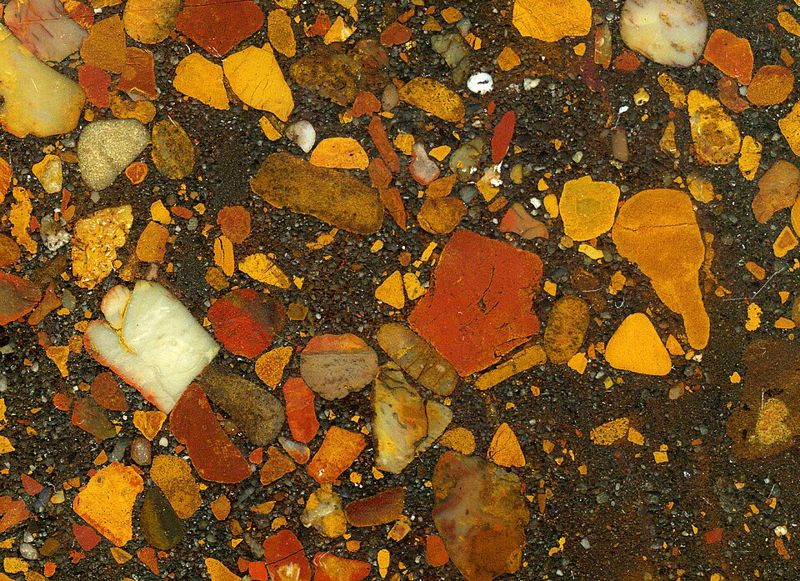
Breccia forms where broken, angular fragments of rock or mineral debris pile up and are later cemented together. Common settings include the base of a cliff or outcrop where weathered debris collects, stream deposits close to that outcrop, alluvial fans, and debris-flow deposits. After the fragments are deposited, a mineral cement or a matrix of finer particles fills the gaps and binds them into solid rock.
The sharp, angular shape of the fragments, which are larger than 2 millimeters, shows they did not travel far, because transport by water grinds edges round. That is the main difference from conglomerate, which has rounded pieces. Geologists also use the term for angular-fragment rocks formed by faulting, volcanic eruptions, and meteorite impacts.
Source: Geology.com: Breccia
Image: Jasper breccia, by James St. John, CC BY 2.0, via Wikimedia Commons.
Related answers
- How are igneous rocks formed and classified?
- What are granitic rocks?
- Are clastic rocks sedimentary?