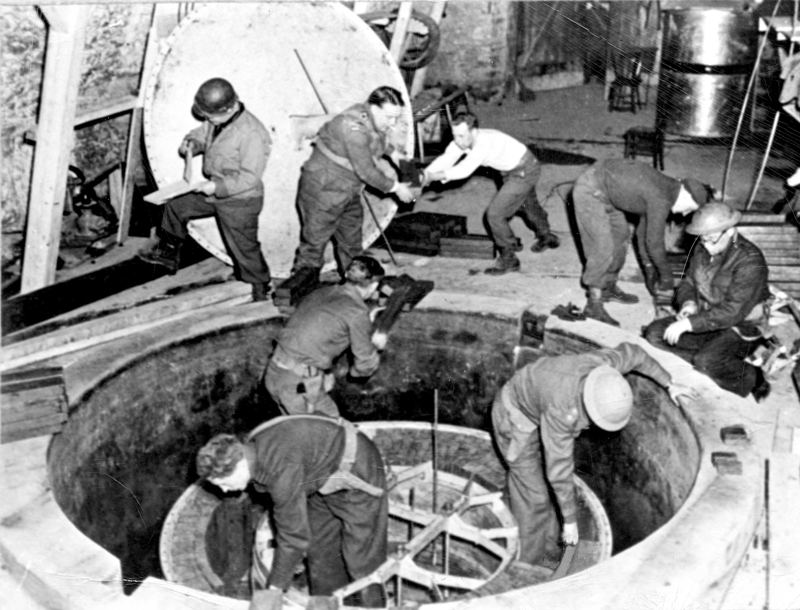
Not very close, according to a new analysis. Germany’s last reactor experiment, the B8 pile that Werner Heisenberg’s team assembled at Haigerloch in 1945 using cubes of natural uranium suspended in heavy water, never reached criticality (a self-sustaining chain reaction). Heisenberg later said it needed only a modest amount of extra uranium, but researchers led by Timothy Koeth, who studied two surviving uranium cubes and archival records, calculated it would have needed about twice as much uranium and more than twice as much heavy water as it held.
Those amounts exceeded what Germany had during the war, especially heavy water from its Norwegian supply. A graphite-moderated design, like the one the United States used for the first sustained chain reaction in 1942, was not a fallback either, because the graphite available to Germany contained boron impurities that absorb neutrons. The study was published in PNAS Nexus (2026; DOI 10.1093/pnasnexus/pgag282).
Image: Allied Alsos Mission soldiers dismantling the German experimental pile at Haigerloch, April 1945. Photo by Sgt. Malcolm (Mickey) Thurgood, U.S. Army, public domain, via Wikimedia Commons.