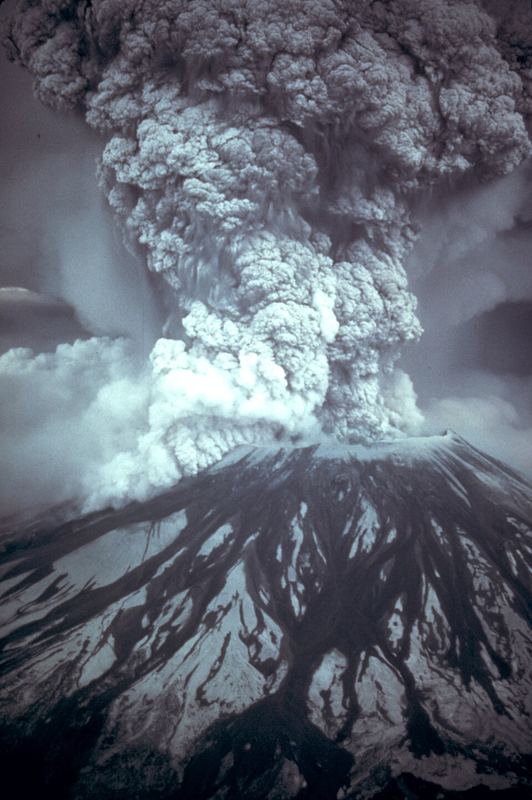
Stratovolcanoes, also called composite volcanoes, are steep, cone-shaped volcanoes built up layer by layer from thick, sticky (viscous) lava flows, volcanic ash and rock fragments (tephra), and pyroclastic flows. The U.S. Geological Survey notes that they usually take tens to hundreds of thousands of years to build, can erupt a range of magma types from basalt to rhyolite, and typically have many separate vents.
Because their thick magma traps gas, stratovolcanoes are known for explosive eruptions. Well-known examples include Mount St. Helens and Mount Rainier in Washington state and Mount Fuji in Japan. They differ from shield volcanoes such as Kilauea in Hawaii, which are broad and gently sloping because they are built mostly from runny basalt lava.
Source: U.S. Geological Survey, Volcano Hazards Program Glossary (Stratovolcano)
Image: Mount St. Helens eruption, May 18, 1980, by Austin Post (USGS), public domain, via Wikimedia Commons.