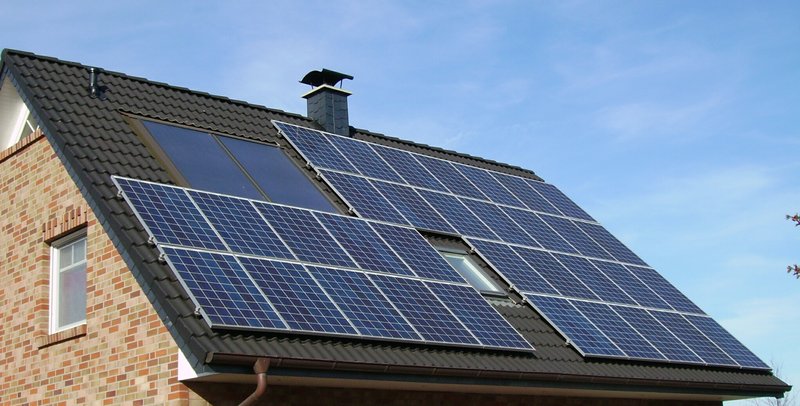
Solar panels use photovoltaic (PV) cells made from semiconductor materials, usually silicon. When sunlight hits a cell, the semiconductor absorbs energy from the light and frees electrons, creating an electrical current inside the cell.
That direct current (DC) is collected through metal contacts on the cell. In a typical rooftop system, an inverter then converts DC into alternating current (AC) that can power a home or feed the electric grid. As long as sunlight reaches the modules and the circuit stays connected, the panels keep generating electricity (U.S. Department of Energy; DOE PV Cells 101).
Source: U.S. Department of Energy: How Does Solar Work?
Image: Solar panels on a roof, photo by Pujanak, public domain, via Wikimedia Commons.