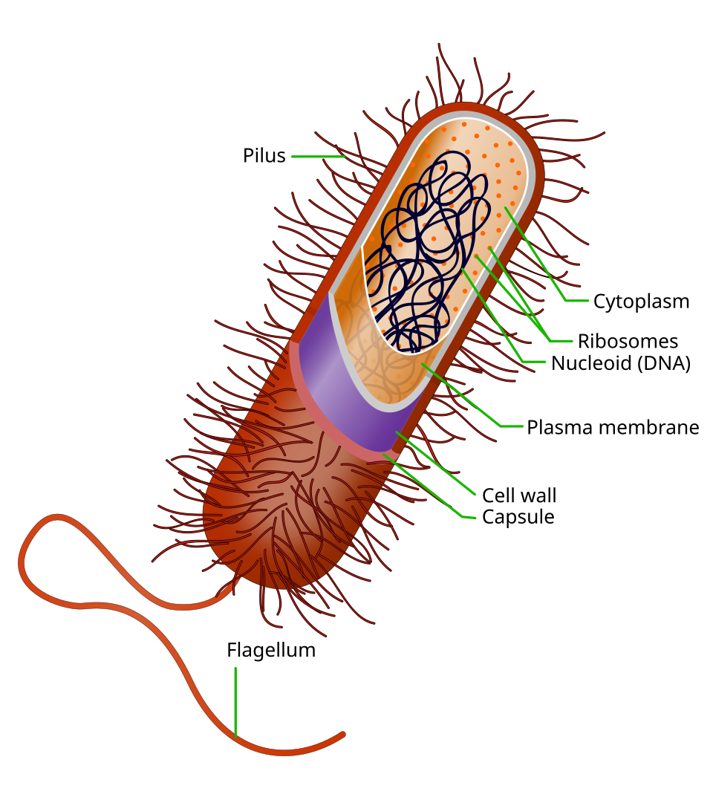
Bacteria are prokaryotic cells: they have no nucleus and generally lack membrane-bound organelles. Every bacterial cell has a plasma membrane enclosing the cytoplasm, 70S ribosomes for making proteins, and DNA, usually a single circular chromosome, concentrated in a region called the nucleoid. Many bacteria also carry small circular DNA molecules called plasmids, and some store nutrients in inclusions.
Most bacteria have a cell wall made of peptidoglycan, a material found only in bacteria. Gram-positive bacteria have a thick peptidoglycan layer (about 30 to 100 nm), while gram-negative bacteria have a thin layer plus an outer membrane containing lipopolysaccharide. Depending on the species, bacteria may also have a capsule or slime layer, hair-like fimbriae and pili for attachment and DNA transfer, flagella for swimming, and, in genera such as Bacillus and Clostridium, the ability to form tough dormant endospores.
Source: OpenStax Microbiology, Unique Characteristics of Prokaryotic Cells
Image: Prokaryote cell diagram by Ali Zifan, CC BY-SA 4.0, via Wikimedia Commons.