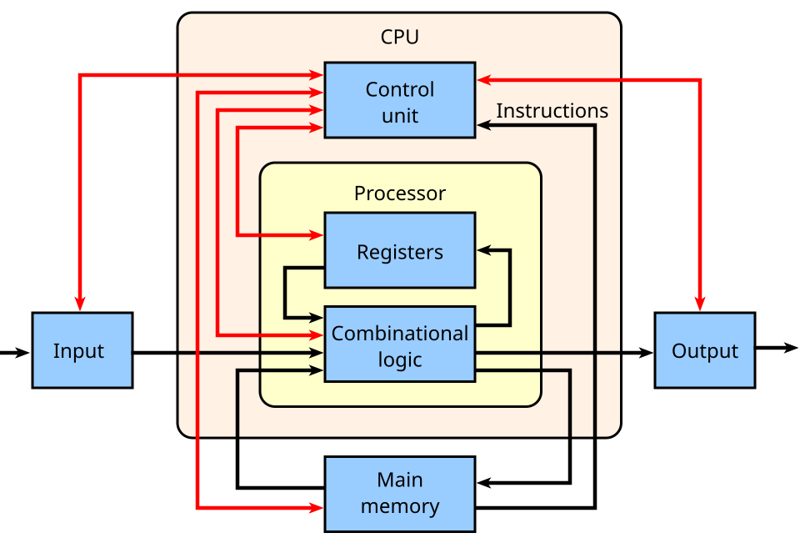
A central processing unit (CPU) has three core parts. The arithmetic logic unit (ALU) performs arithmetic and logic operations such as addition, comparison, AND, and OR. Registers are small, very fast storage locations inside the chip that hold the data, addresses, and results an instruction is working on. The control unit, with special-purpose registers such as the program counter, fetches and decodes each instruction and sends the signals that tell the ALU, registers, and memory what to do.
A clock drives the circuitry so instructions advance in step, and internal buses carry data between the ALU and registers. Modern processors also put cache memory on the chip, which keeps recently used data and instructions close by so the CPU does not have to wait on slower main memory (RAM), and most now contain several complete processing cores.
Source: Dive Into Systems, Section 5.5: The CPU
Image: Block diagram of a basic computer by Lambtron, CC BY-SA 4.0, via Wikimedia Commons.