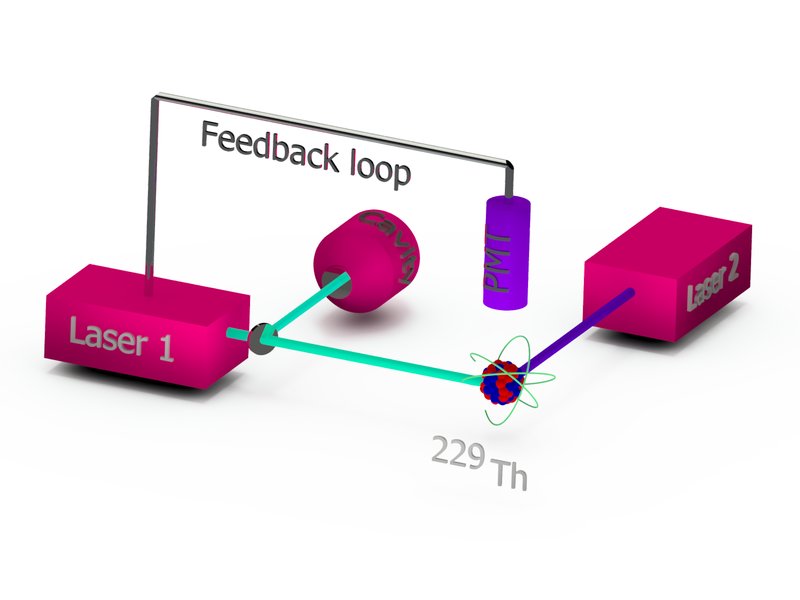
A nuclear clock is a precision timekeeper that measures time using an energy transition inside an atom’s nucleus, rather than among the electrons that surround the nucleus as ordinary atomic clocks do. Researchers focus on the isotope thorium-229, whose nucleus has an unusually low-energy jump that can be driven with vacuum-ultraviolet laser light.
Because the nucleus is tightly bound and better shielded from outside electrical and magnetic noise than electrons are, a nuclear clock could become an exceptionally stable frequency standard and a sensitive probe of fundamental physics, including possible changes in physical constants linked to dark matter. In 2026, research teams in Europe and China reported locking continuous-wave lasers to the thorium nuclear resonance—an important step toward practical nuclear clocks.