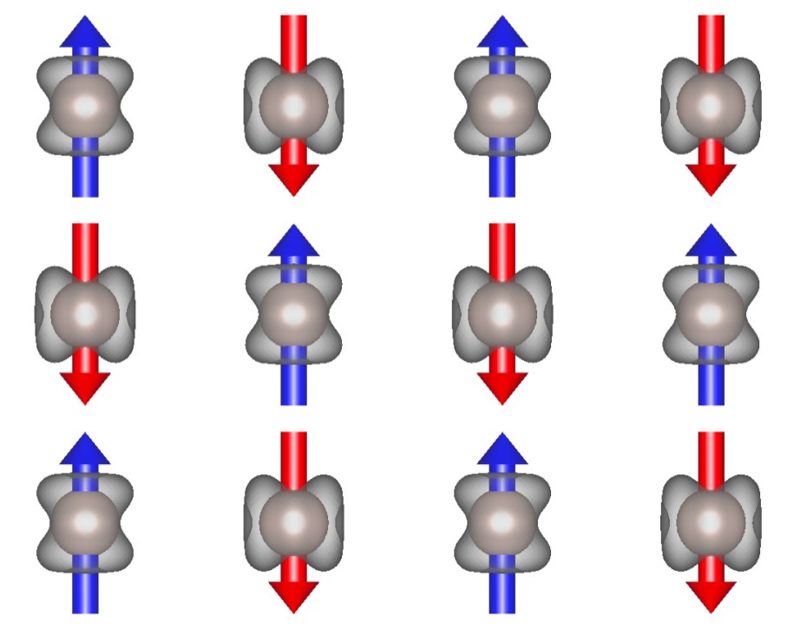
Altermagnetism is a newly recognized third type of collinear magnetic order, alongside ferromagnetism and antiferromagnetism. Like an antiferromagnet, an altermagnet’s magnetic moments cancel out so it has no net magnetization, yet its electrons behave in ways previously associated with ferromagnets, such as carrying strongly spin-polarized electrical currents, combined with very fast magnetic dynamics.
The theory was developed by Libor Šmejkal, Jairo Sinova (Johannes Gutenberg University Mainz) and Tomas Jungwirth (Czech Academy of Sciences), who published a full symmetry classification in 2022 identifying hundreds of candidate materials; experiments using ARPES and electrical-transport measurements later confirmed altermagnetic behavior in several of them. The three physicists were named recipients of the 2026 Europhysics Prize for the work, which researchers say could lead to faster spintronic devices.
Image: Illustration of alternating spins and orientations on neighboring magnetic sites in an altermagnet, by Libor Šmejkal, CC BY-SA 4.0, via Wikimedia Commons.
Related answers
- Is Oumuamua still debated among top scientists?
- What are the winter 2026/2027 snowfall predictions?
- Did a microalgae bloom shut down Israel’s desalination plants?