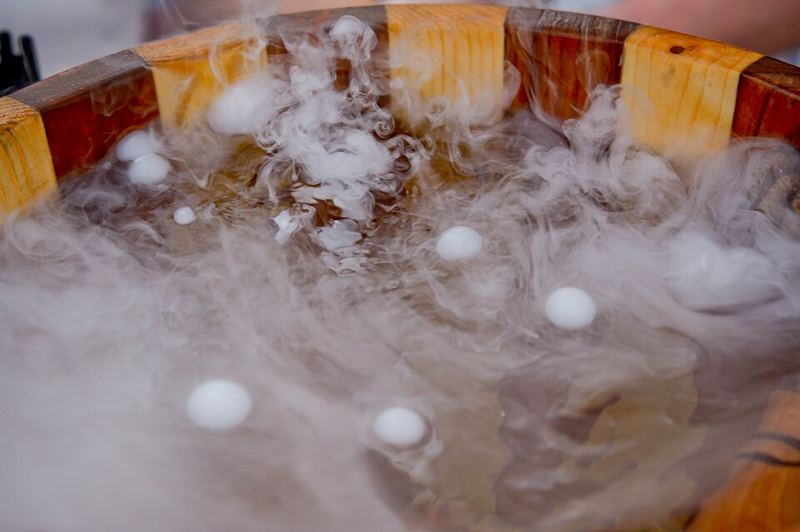
Dry ice does not actually smoke. It is solid carbon dioxide, and at room temperature it sublimates, turning straight from a solid into carbon dioxide gas, which is invisible. The white cloud you see is a fog of tiny liquid water droplets: the extremely cold gas chills nearby moisture until water vapor condenses into droplets, the same way your breath fogs on a cold day.
When dry ice is dropped into water, experiments described by chemistry educator Tom Kuntzleman on ChemEdX show that most of the fog comes from the water in the container, not from humidity in the room. The sublimating carbon dioxide forms cold bubbles around the dry ice, water evaporates into those bubbles and immediately condenses into droplets, so the bubbles are already cloudy when they rise and burst at the surface. Because the cold, droplet-laden gas is denser than air, the fog spills over the rim and creeps along the floor.
Source: Tom Kuntzleman, “The Dry-Ice-in-Water Cloud,” Chemical Education Xchange (ChemEdX)
Image: Dry ice in cold water, by Nina Ladygina-Glazounova, CC BY 4.0, via Wikimedia Commons.
Related answers
- How cold is dry ice?
- Is Antarctic sea ice growing or shrinking?
- Do Antarctic ice cliffs collapse in a runaway cascade?
1 thought on “Why does dry ice smoke?”