
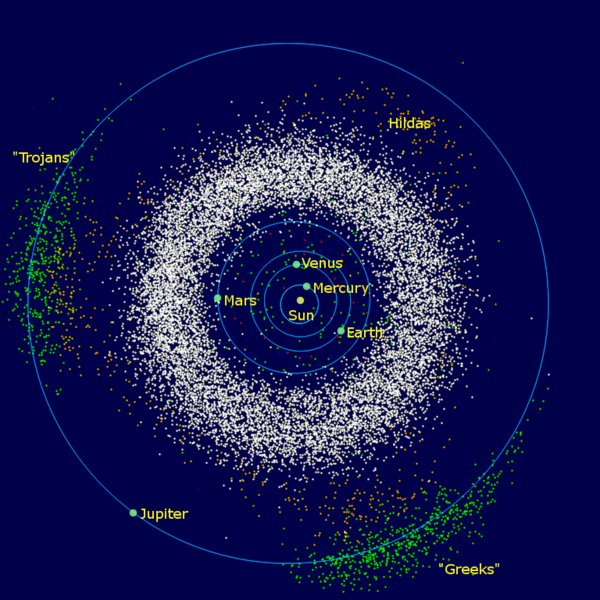
The main asteroid belt lies between the orbits of Mars and Jupiter, where most known asteroids circle the Sun.
NASA estimates the belt holds between 1.1 and 1.9 million asteroids larger than 1 kilometer (0.6 miles) across, plus millions of smaller ones. Most belt asteroids follow orbits that are not very elongated. Despite those numbers, the combined mass of all asteroids is less than that of Earth’s Moon. The largest asteroid, Vesta, is about 329 miles (530 kilometers) in diameter. The belt exists because the gravity of newly formed Jupiter stopped planets from forming in that region early in the solar system’s history and made the small bodies there collide and break into the fragments seen today. Jupiter’s gravity, along with occasional close passes by Mars, can still knock asteroids out of the belt and send them across the orbits of other planets. Not every asteroid lives in the belt: the Jupiter trojans share Jupiter’s orbit and are thought to be about as numerous as belt asteroids, and near-Earth asteroids have orbits that pass close to Earth’s.
Source: NASA Science, Asteroids: Facts
Image: Diagram of the inner solar system and asteroid belt by Mdf, public domain, via Wikimedia Commons.