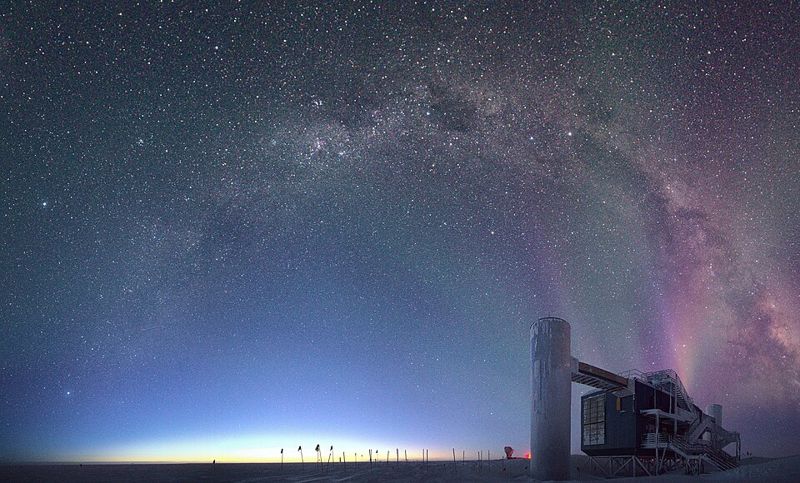
Short answer: Francis Halzen of the University of Wisconsin–Madison won the 2026 Nobel Prize in Physics, announced on October 6, 2026. The Royal Swedish Academy of Sciences gave him the full prize “for decisive contributions to the IceCube Neutrino Observatory and the discovery of high-energy neutrinos of astrophysical origin.”
Halzen first proposed using the clear ice at the South Pole to detect neutrinos in 1988. IceCube, a cubic kilometre of ice fitted with light sensors, was finished in 2011, and researchers then found high-energy neutrinos that come from far outside our solar system. Halzen was born in 1944 in Tienen, Belgium, and the prize is worth 12 million Swedish kronor.
Source: NobelPrize.org: Press release, Nobel Prize in Physics 2026
Image: The ICL at Dawn by John Hardin, CC BY 4.0, via Wikimedia Commons.