
Last updated: November 4, 2026
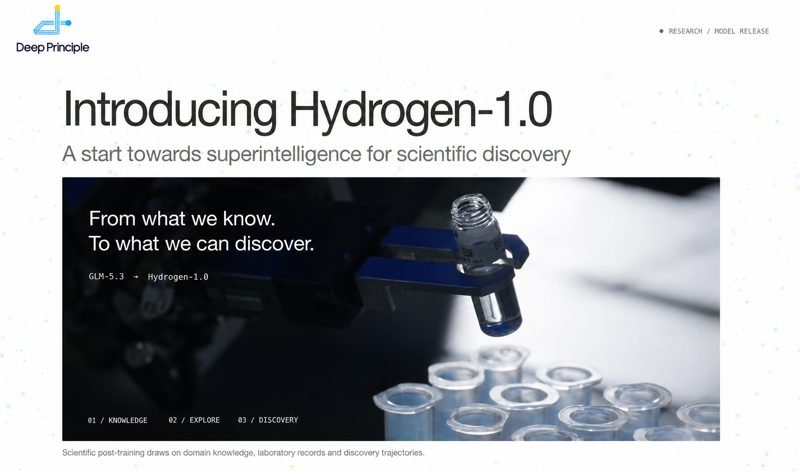
Hydrogen-1.0 is a new open-weight scientific model from Deep Principle, post-trained from GLM-5.3 for chemistry, materials science and life sciences. It lists a 1M-token context and 128K-token output, ships MIT-licensed BF16, NVFP4 and MXFP4 weights, and is also available through the NeuroSpark API and the Mira app.
Contents
- What Hydrogen-1.0 is
- Versions and hardware
- Reported results
- Four ways to access it
- How to run it on your own GPUs
- Reasoning effort and output budgets
- How it compares
- Limitations
- Frequently asked questions
Most models that have shown real research results are proprietary. Deep Principle released Hydrogen-1.0 as an open alternative that researchers can inspect, adapt and host themselves. This guide covers what shipped, what the published results show and how to serve the model, using the Introducing Hydrogen-1.0 launch post and the official Hugging Face model cards.
What Hydrogen-1.0 is
According to the Hydrogen-1.0 model card, the model works through text interaction. It is intended to help with scientific questions, explain equations and derivations, and draft structured answers to open-ended research problems for expert review. The Hugging Face repository was created on October 31, 2026, and the release was announced on the Deep Principle blog in early November.
| Item | Details |
|---|---|
| Publisher | Deep Principle |
| Base model | GLM-5.3 by Z.AI |
| Parameters | About 753 billion (Hugging Face listing for the BF16 weights) |
| Context length | 1M tokens (model card) |
| Maximum output | 128K tokens (model card) |
| Domains | Chemistry, materials science and life sciences |
| Training | Supervised fine-tuning and reinforcement learning on domain knowledge, research scenarios, laboratory records and discovery trajectories |
| Weights license | MIT License |
| Docs and example code | Apache License 2.0 |
Full training datasets and recipes are not released with the weights. The launch post says the training stack builds on Megatron and SGLang and runs on both NVIDIA CUDA and AMD ROCm hardware.
Versions and hardware
Deep Principle publishes three separate repositories. Do not mix tokenizer, template or configuration files between them, since each build depends on its own matching files for correct stopping behavior.
| Version | Repository | Notes | Tested hardware |
|---|---|---|---|
| BF16 (unquantized) | deep-principle/Hydrogen-1.0 | Full weights; gated, so you accept the access conditions on Hugging Face first | Sufficient memory and a compatible runtime |
| NVFP4 | deep-principle/Hydrogen-1.0-NVFP4 | Quantized with NVIDIA ModelOpt; about 464 GB of files | Team-tested with SGLang on 8x NVIDIA B300 |
| MXFP4 | deep-principle/Hydrogen-1.0-MXFP4 | Quantized with AMD Quark, 32-element groups with E8M0 scales | Team-tested with ATOM on AMD Instinct MI350X, tensor parallel 4 |
The NVFP4 model card notes that attention, the router, embeddings and the output layer stay in BF16, and that quantization may affect outputs. Validate the exact version you deploy for your task.
Reported results
The launch post reports that Hydrogen-1.0 outperforms GPT-6-Astra on FrontierScience-Research and improves over GLM-5.3 on GPQA Diamond, roughly matching the open model Kimi-K3. Its cost charts use GLM-5.3 pricing for Hydrogen-1.0.
- Scientific computing and reaction prediction: compared with GPT-6-Astra at maximum thinking, Hydrogen-1.0 leads by 5.13 and 4.76 percentage points in Deep Principle’s internal tests.
- NMR structure elucidation: GPT-6-Astra at maximum thinking still scores 3.33 points higher.
- Experiment planning: Hydrogen-1.0 scores higher than Kimi-K3 on 117 shared lab-planning questions.
- Materials discovery: in a five-round transition metal complex search, its mean best HOMO-LUMO gap reached 4.318 eV, versus 3.689 eV for GPT-6-Astra and 3.353 eV for Kimi-K3.
The post also shows the model writing and repairing a GROMACS polymer simulation, building a 27-structure reaction network and compiling a robot lab protocol. All of these are vendor-run evaluations.
Four ways to access it
The launch post lists four routes: download weights from Hugging Face or ModelScope, call the model through the NeuroSpark API, or use it inside Mira, Deep Principle’s AI Scientist application. If you only want to test prompts, a hosted route avoids the hardware cost. Our Hugging Face hf CLI guide explains gated downloads and local folders.
How to run it on your own GPUs
This example follows the NVFP4 model card for an NVIDIA Blackwell cluster.
- Install an SGLang build that supports the ModelOpt NVFP4 export format.
- Launch the server:
python -m sglang.launch_server --model-path deep-principle/Hydrogen-1.0-NVFP4 --served-model-name hydrogen-1.0 --tp 8 --trust-remote-code --quantization modelopt_fp4 --kv-cache-dtype fp8_e4m3 --reasoning-parser glm45 --tool-call-parser glm47 --context-length 262144 --port 8001. - Confirm the model ID by requesting
/v1/models; it should returnhydrogen-1.0. - Install the client with
pip install openaiand setMODEL_BASE_URLtohttp://localhost:8001/v1. - Send a Chat Completions request with a system prompt such as “State assumptions and explain the scientific reasoning behind your answer.”
- Check
finish_reasonon every response. A value oflengthmeans the answer was cut off and the budget needs raising.
Note that this command caps context at 262,144 tokens, not the stated 1M. On AMD hardware, the MXFP4 model card uses python -m atom.entrypoints.openai_server with -tp 4 and --server-port 8001, since ATOM’s --port flag is for internal engine traffic. For other serving options, see our vLLM 0.32 guide.
Reasoning effort and output budgets
The usage notes show extra_body={"chat_template_kwargs": {"reasoning_effort": "max"}}. If your server expects a top-level parameter, pass reasoning_effort="max" instead, but do not use both. The {a(GLM,”GLM-5.3 model card”)} lists three levels for the base model, low, high and max, with max as the default.
- Raise max_tokens for hard problems: the example uses 4,096 tokens, which long reasoning can exhaust before a final answer appears.
- Watch concurrency: in Deep Principle’s MI350X test, 128 concurrent long reasoning requests filled the KV cache and sharply reduced answer quality, while 48 requests stayed below 75% usage.
- Leave sampling to the server: if you omit temperature and top_p, the server defaults apply.
How it compares
Hydrogen-1.0 is a domain specialist built on the same base as Z.AI’s own variants, such as the legal model in our GLM-5.3-FlashX-Legal guide. General open models like the one in our Kimi K3.1 Pro guide cover coding and agent work more broadly. For a recent open multimodal option, see the Tencent Hy4 guide. Choose Hydrogen-1.0 when your work centers on chemistry, materials or life sciences and you want weights you can host and adapt.
Limitations
- The model can produce incorrect facts, calculations, equations or references, and a confident answer does not mean a correct one.
- Outputs are supporting material, not verified findings, and should not drive health or safety decisions on their own.
- Long context does not guarantee reliable use of every input detail.
- The BF16 repository is gated, and the hardware needs put self-hosting out of reach for most individuals.
- Published results are vendor evaluations, and some demonstrations relied on external tools and lab environments.
Frequently asked questions
What is the Hydrogen-1.0 model?
Hydrogen-1.0 is an open-weight scientific model from Deep Principle, built by post-training Z.AI’s GLM-5.3 on chemistry, materials science and life sciences data, plus laboratory records and agent trajectories. It is meant to help with scientific questions, derivations, experiment planning and open-ended research problems.
How large is Hydrogen-1.0 and what context does it support?
The Hugging Face listing reports about 753 billion parameters for the BF16 weights. The model card lists a 1M-token context length and a maximum output of 128K tokens, though the usable budget depends on your inference framework, settings and hardware.
Is Hydrogen-1.0 free to use commercially?
The model weights are released under the MIT License, and Deep Principle’s own model-card text and example code are under Apache-2.0. You must keep the included copyright and permission notices, and third-party files keep their own licenses. Check the license files before redistributing.
What hardware do the quantized versions need?
Deep Principle reports testing the NVFP4 build with SGLang on eight NVIDIA B300 GPUs and the MXFP4 build with ATOM on AMD Instinct MI350X at tensor parallel 4. The NVFP4 repository holds about 464 GB of files, so this is a data-center model, not a laptop model.
Can I use Hydrogen-1.0 without hosting it?
Yes. The launch post lists four access routes: open weights on Hugging Face and ModelScope, API access through NeuroSpark, and use inside Deep Principle’s Mira AI Scientist application. Pricing for the hosted routes is not stated in the launch post.
How does Hydrogen-1.0 compare with GLM-5.3?
In Deep Principle’s own evaluations, Hydrogen-1.0 improves over GLM-5.3 on GPQA Diamond and outperforms GPT-6-Astra on FrontierScience-Research, roughly matching Kimi-K3. These are vendor-reported results, so test the model on your own scientific tasks.
Sources
- Introducing Hydrogen-1.0 (Deep Principle blog)
- Hydrogen-1.0 model card (Hugging Face)
- Hydrogen-1.0-NVFP4 model card (Hugging Face)
- Hydrogen-1.0-MXFP4 model card (Hugging Face)
- GLM-5.3 model card (Z.AI, Hugging Face)
Image: Hydrogen-1.0 release illustration by Deep Principle, from the Hydrogen-1.0-NVFP4 model card, whose documentation is licensed under Apache-2.0 (resized). FreeAnswers is not affiliated with or endorsed by Deep Principle.