
Last updated: November 25, 2026
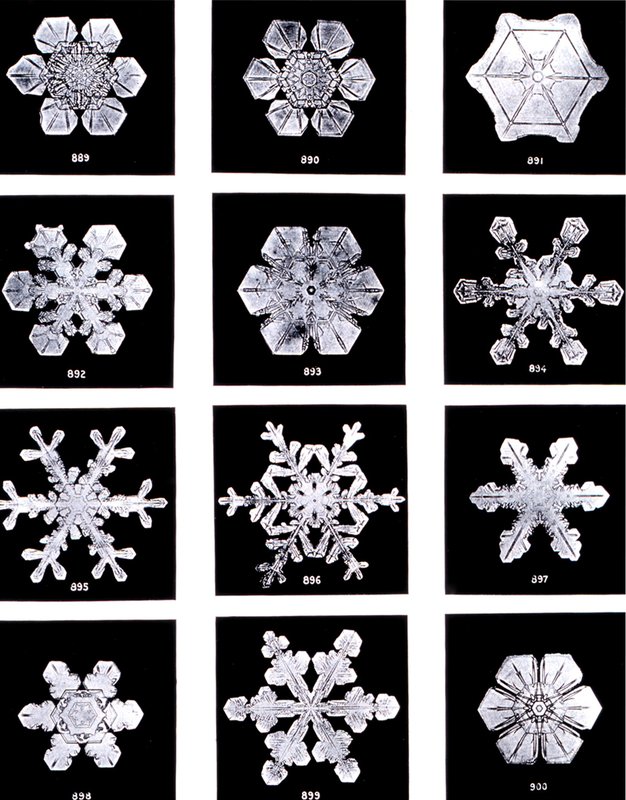
How do snowflakes form? A snowflake begins high in a cold cloud when a tiny water droplet freezes, often around a speck of dust or pollen, into an ice crystal. Water vapor then freezes directly onto that crystal as it falls, building six arms whose shape depends mostly on the temperature and humidity.
This guide walks through each stage, explains why snowflakes have six sides, and shows which shapes form at which temperatures.
Contents
- How are snowflakes formed, step by step?
- What is the difference between a snowflake and a snow crystal?
- Why are snowflakes six-sided?
- Why are snowflakes symmetrical?
- What shapes do snowflakes form at different temperatures?
- Are all snowflakes unique?
- Is snow just frozen rain?
- How can you see snowflake shapes yourself?
- Frequently asked questions
How are snowflakes formed, step by step?
According to NOAA and the UK Met Office, a snowflake grows in these stages:
- A droplet freezes. Cloud droplets can stay liquid well below 32 °F (0 °C); this is called supercooled water. The Met Office explains that droplets freeze on their own only at about -35 °C (-31 °F) or colder. In warmer clouds they need a nucleus, such as a particle of dust or pollen, to freeze onto.
- A tiny hexagonal crystal appears. The new ice particle starts as a small six-sided plate, according to Caltech physicist Kenneth Libbrecht.
- Water vapor builds it up. Water vapor in the air turns directly into ice on the crystal’s surface, so the crystal grows without the vapor first becoming liquid.
- Arms sprout. As the crystal gets larger, branches grow from its six corners.
- The crystal falls and changes. As it tumbles through the cloud, changes in temperature and humidity alter how the arms grow, adding side branches, plates and other details.
- Crystals may clump. Hundreds or even thousands of crystals can collide and stick together on the way down, forming the fluffy flakes you see in a heavy snowfall.
The clouds that make snow are related to other ice-crystal clouds; see what cirrocumulus clouds are made of for a high-altitude example.
What is the difference between a snowflake and a snow crystal?
A snow crystal is a single crystal of ice in which the water molecules line up in a precise hexagonal pattern. “Snowflake” is a broader term. It can mean one snow crystal, but it can also mean a clump of many crystals stuck together, or almost anything that falls from winter clouds. Libbrecht compares it to calling a tulip a flower: both terms are correct.
Why are snowflakes six-sided?
The Met Office explains that the molecules in ice crystals join together in a hexagonal structure, which is the most efficient way for water molecules (each made of one oxygen and two hydrogen atoms) to fit together. That molecular pattern produces a six-sided starting crystal, and six corners lead to six arms.
Why are snowflakes symmetrical?
The six arms grow independently. Nothing links them. They match because all six arms travel together through the cloud, so they experience the same temperature and humidity at the same moment. When conditions change, every arm changes the same way, as NOAA notes.
Libbrecht compares this to neighbors who each grab an umbrella on a rainy day without talking to one another: they react to the same weather, so their behavior lines up.
What shapes do snowflakes form at different temperatures?
Temperature decides the basic shape of a snow crystal, and humidity decides how complex it becomes. Japanese physicist Ukichiro Nakaya mapped this in the 1930s by growing crystals in a cold laboratory, and his chart is still known as the snow crystal morphology diagram, according to SnowCrystals.com.
| Temperature | Typical crystal shape | Notes |
|---|---|---|
| About 28 °F (-2 °C) | Thin plates | Smaller and prone to melting because they are close to the freezing point |
| About 23 °F (-5 °C) | Long needles | NOAA’s example of needle-like crystals |
| About 21 °F (-6 °C) | Slender columns | Columns that later drift into colder air can grow plates on each end, called capped columns |
| About 5 °F (-15 °C) | Large, thin plates and star-shaped crystals | The best temperature for finding large, plate-like snowflakes |
| Below about -4 °F (-20 °C) | Plates or columns | Either form can appear |
Humidity adds a second layer. When the air holds little moisture, crystals grow slowly into simple shapes. When humidity is high, they grow quickly into complex, branched forms. Need to convert these readings? Use the Celsius to Fahrenheit conversion chart.
What scientists still do not know
The diagram describes what happens, but researchers still cannot fully explain why ice grows as thin plates at some temperatures and slender columns at others. The answer depends on the molecular behavior of ice surfaces, which remains an open question.
Are all snowflakes unique?
As a general rule, yes. Each snowflake takes a slightly different path to the ground and meets slightly different conditions along the way, so complex snowflakes tend to look different, NOAA explains. The Met Office adds that the claim is impossible to test fully, because no one can examine every snowflake, but the possible combinations of temperature and humidity are limitless.
Libbrecht has grown “identical-twin” snowflakes in his laboratory by exposing two tiny seed crystals to nearly identical conditions. The result shows what would happen if two crystals fell side by side through the same air.
Is snow just frozen rain?
No. Snow crystals form when water vapor turns directly into ice without becoming liquid first. Raindrops that freeze on the way down are called sleet, according to Libbrecht. Snow also looks white even though each crystal is clear: the Met Office explains that the many surfaces of the ice crystals scatter the whole spectrum of light. For background on how water turns to ice, see what a freezing point is.
How can you see snowflake shapes yourself?
Seeing snow crystals up close takes very little equipment. Libbrecht’s snowflake watching guide recommends a simple approach:
- Carry a magnifier. A 3X lens works, but 5X is better. A fold-up magnifier fits in a coat pocket.
- Test it at home. If you can see the Lincoln Memorial on the back of a penny, the magnifier is strong enough.
- Use your sleeve. In a gentle snowfall, let a few flakes land on your sleeve and look closely.
- Pick the right weather. Large plate-like crystals are most likely near 5 °F (-15 °C), according to the morphology diagram.
- Be patient. Not every snowfall brings well-formed crystals. If you see nothing interesting after about 5 minutes, try another day.
Planning a winter outing? The winter solstice guide covers the shortest day of the year. If you head out during a storm, review how to drive in snow first.
Frequently asked questions
How are snowflakes formed?
A snowflake begins when a very cold cloud droplet freezes, often onto a speck of dust or pollen, and becomes an ice crystal. Water vapor then freezes onto that crystal as it falls, building the six arms of the snowflake.
Why are snowflakes six-sided?
Water molecules in ice join together in a hexagonal structure. That six-sided arrangement shapes the crystal from the start, so arms sprout from its six corners.
Are all snowflakes unique?
As a general rule, yes. Each snowflake follows a slightly different path through the clouds and meets slightly different temperature and humidity, so complex snowflakes almost never look exactly alike.
What temperature do snowflakes form at?
Snow crystals take different shapes at different temperatures below freezing. Thin plates grow near 28 °F (-2 °C), slender columns near 21 °F (-6 °C) and large thin plates near 5 °F (-15 °C).
Is snow frozen rain?
No. Snow crystals form when water vapor turns directly into ice without first becoming liquid. Raindrops that freeze as they fall are called sleet.
Why is snow white?
Individual snowflakes are actually clear. The many faces of the ice crystals reflect and scatter the whole spectrum of light, so snow looks white.
Sources
- NOAA: How do snowflakes form? Get the science behind snow
- Met Office: Snowflakes
- SnowCrystals.com (Kenneth Libbrecht, Caltech): Snowflake Science
- SnowCrystals.com: Snow Crystal Morphology Diagram
- Caltech (Kenneth Libbrecht): Snowflake Watching