
Last updated: November 27, 2026
Here is how to put on snow chains: park on level ground well off the road, set the parking brake, lay the chains flat with the hooks facing away from the tire, drape them over the drive tires, roll forward slightly, fasten the inside connector, then the outside one, and retighten after a short drive.
Below are the full steps, plus the chain laws in California, Washington and Colorado.
Contents
- What you need before you put on snow chains
- Which tires do snow chains go on?
- How to put on snow chains, step by step
- How to take off snow chains
- How fast can you drive with snow chains?
- Chain laws: when are snow chains required?
- Common snow chain mistakes to avoid
- Frequently asked questions
What you need before you put on snow chains
Learn how to put on tire chains at home, not on a snowy shoulder. Laclede advises trying chains on as soon as you buy them, since tire sizes vary and snow tires may need a size larger than regular tires (Laclede installation instructions). Peerless says a correctly sized chain should drape at least 2 inches over each side of the tire from the edge of the tread (Peerless instructions).
Correct tire inflation matters too; see our guide on how to check tire pressure before a winter trip.
Which tires do snow chains go on?
Caltrans states that chains must be installed on the drive wheels, so make sure you know whether your vehicle is front- or rear-wheel drive. On a front-wheel-drive car, chains go on the front tires; on a rear-wheel-drive car, the rear tires. For all-wheel and four-wheel drive vehicles, Caltrans says it is best to check the vehicle manufacturer’s specifications for tire chains and traction devices (Caltrans chain controls).
How to put on snow chains, step by step
These steps follow the installation instructions for a common passenger link chain from Peerless. Cable and self-tensioning chains differ, so also check your own chains’ instructions.
- Pull completely off the road. Caltrans says to wait until you can pull completely off the roadway to the right and never stop in a traffic lane. Park on firm, level ground, turn off the engine and set the parking brake.
- Lay the chains out flat. Unroll each chain and remove all twists and tangles. The smooth side of the cross chain hooks should face the tire.
- Drape the chain over the tire. Keep the cross chain hooks facing upward, away from the tire. Hooks that face the tire can damage it.
- Roll forward slightly. Pull one cross chain down to where the tire meets the ground, then move the vehicle so that one or two cross chains pass under the tire.
- Fasten the inside connector. Reach behind the tire and hook the inside connector on the second or third link.
- Fasten the outside connector. Pull the chain as tight as possible and close the outside fastener.
- Add a tensioner. If your chains use a rubber tensioner, hook it at alternating points around the wheel, such as the 5 o’clock and 11 o’clock positions.
- Drive a short distance and retighten. Peerless says to drive a short distance and retighten all fasteners; Laclede specifies about a quarter mile.
The drive-over method
Laclede describes an alternative: lay the chain flat, spread the second and third cross chains apart, and drive onto the chain so the tire rests between them. Then attach the inside hook, then the outside fastener (Laclede).
How to take off snow chains
In California, drive beyond the “End of Chain Control” signs to a pull-off area before removing chains (Caltrans). Peerless gives these removal steps:
- Stop on safe, level ground off the highway, turn off the engine and set the brake.
- Unhook the tensioner and the outside fastener, then the inside fastener.
- Lay the chains on the ground and drive the vehicle off them.
- Inspect the chains for damage or wear, then clean and lubricate them.
How fast can you drive with snow chains?
The speed limit in California when chains are required is 25 or 30 miles per hour (Caltrans). Laclede’s instructions say not to exceed 30 mph, to accelerate slowly and to avoid spinning wheels or locking them when braking. For more on handling slippery roads, read our guide on how to drive in snow.
Chain laws: when are snow chains required?
Chain controls are posted on highway signs, and the rules differ by state.
| State | Levels | What passenger vehicles need | Penalty |
|---|---|---|---|
| California | R1, R2, R3 | R1: chains unless a passenger vehicle or light truck under 6,000 lb has snow tires on at least two drive wheels. R2: chains or traction devices unless 4WD/AWD with snow-tread tires on all four wheels (which must carry devices). R3: chains or devices on all vehicles. | California Highway Patrol may cite and fine drivers |
| Washington | Traction tires required; chains required; chains required on all vehicles | Chains required: all vehicles except 4WD/AWD, which must carry chains. In extreme weather, all vehicles must chain up. Studded tires do not count. | $500 fine |
| Colorado | Traction law; chain law | Traction law: tires with 3/16-inch tread rated all-weather, M+S or winter, or carry chains or an approved device. Chain law: every vehicle must have chains or an approved alternative traction device. | $100 fine plus $33 surcharge; $500 plus $157 if it leads to a lane closure |
Sources: Caltrans, WSDOT Winter Driving Guide and Colorado DOT. A highway is often closed before California imposes R3.
Snow chains vs. snow socks and other traction devices
Snow socks and similar products are alternative traction devices. Washington’s guide lists state-approved options for passenger vehicles, including AutoSock, Grip Tex and ISSE Safety (WSDOT), and Colorado publishes its own approved list (CDOT). Only use a device the state you are driving in has approved.
Common snow chain mistakes to avoid
- Stopping in a traffic lane to install chains instead of pulling fully off the road.
- Installing chains with hooks facing the tire, which can damage the tire.
- Driving on bare pavement with chains, which Laclede says to avoid by removing them.
- Driving on a broken chain. If a chain breaks, pull over immediately and remove, tie back, repair or replace it.
Cold weather is also hard on batteries, so it is worth knowing how to jump-start a car before you head into the mountains. For the science of snow, see how snowflakes form.
Frequently asked questions
Do snow chains go on the front or back tires?
Snow chains go on the drive wheels, according to Caltrans. That means the front tires on a front-wheel-drive car and the rear tires on a rear-wheel-drive vehicle; for all-wheel or four-wheel drive, check your vehicle manufacturer’s specifications.
How fast can you drive with snow chains on?
In California chain control areas the speed limit is 25 or 30 miles per hour. Chain makers such as Laclede also say not to exceed 30 mph and to avoid spinning or locking the wheels.
Do I need snow chains if I have AWD or 4WD?
Often you must at least carry them. In California, all-wheel and four-wheel drive vehicles with snow-tread tires on all four wheels are exempt at the R2 level but must carry traction devices, and at R3 every vehicle needs chains. Washington can also require chains on all vehicles in extreme weather.
Can you drive on pavement with snow chains?
You should not. Laclede’s instructions say to remove tire chains when driving on bare pavement, and Peerless warns against using them on bare pavement.
Are snow socks legal instead of chains?
In some states, yes. Washington and Colorado list approved alternative traction devices, such as AutoSock, that can be used when chains are required, but check the rules for the state you are driving in.
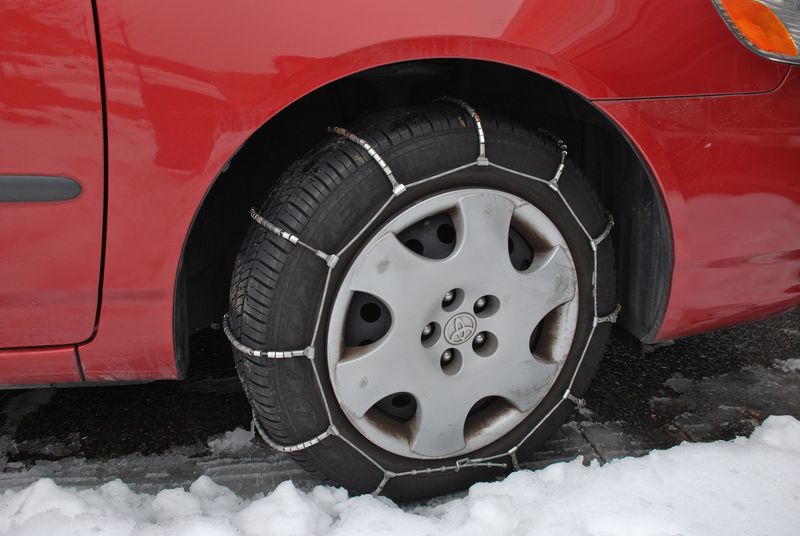
Featured image: “Cable chains on car tire” by Steve Morgan, via Wikimedia Commons, licensed CC BY-SA 3.0; resized. This guide is general information; always follow posted signs and instructions from highway officials.

Sources
- Caltrans: Chain Controls / Chain Installation
- Washington State DOT: Winter Driving Guide (PDF)
- Colorado DOT: Passenger Vehicle Traction and Chain Laws
- Peerless (Security Chain Company): passenger link chain installation instructions (PDF)
- Laclede Chain: passenger-link tire chain installation instructions (PDF)