
Last updated: November 19, 2026
To see the northern lights, you need three things at once: geomagnetic activity strong enough for your latitude, a clear and dark sky, and a view toward the northern horizon. Go out between about 10 p.m. and 2 a.m., away from city lights, and check an aurora forecast first.
Below: the steps, a Kp chart for your area, the best times, where to see the northern lights, and how a phone helps.
Contents
- How to see the northern lights: step by step
- What Kp index do you need to see the northern lights?
- What is the best time to see the northern lights?
- Where is the best place to see the northern lights?
- How to see the northern lights with your phone
- Common mistakes that hide the aurora
- Frequently asked questions
How to see the northern lights: step by step
The aurora borealis forms when energized electrons strike oxygen and nitrogen in the upper atmosphere, typically 80 to 500 km above the ground (NOAA). See what causes the northern lights for the science. Then follow these steps:
- Check the space weather forecast. Use the NOAA Space Weather Prediction Center 30-minute aurora forecast, which shows the expected location and intensity of the aurora 30 to 90 minutes ahead.
- Compare the Kp forecast with your location. Use the table below to see whether activity will be strong enough where you are.
- Check your local weather. The aurora is far above the clouds, so you need a mostly clear sky (NASA).
- Pick a dark site with a northern view. Get away from city lights. A hilltop with an open view to the north lets you see aurora up to about 1,000 km (600 miles) farther north (NOAA).
- Go out near midnight. The most active displays usually happen between 10 p.m. and 2 a.m. local time (NOAA).
- Let your eyes adjust and be patient. Use a red light instead of a white one, dress warmly, and wait. Displays can wax and wane through the night (NASA).
What Kp index do you need to see the northern lights?
The Kp index measures geomagnetic activity on a scale from 0 to 9, and a Kp of 5 or more counts as a geomagnetic storm (NOAA). The higher the Kp, the farther from the poles the aurora reaches. For a short primer, see what the Kp index means for auroras.
| Kp (NOAA storm level) | How far south aurora has been seen in the U.S. | Average frequency per 11-year solar cycle |
|---|---|---|
| Kp 5 (G1 Minor) | Commonly visible at high latitudes, such as northern Michigan and Maine | About 1,700 times (900 days) |
| Kp 6 (G2 Moderate) | As low as New York and Idaho | About 600 times (360 days) |
| Kp 7 (G3 Strong) | As low as Illinois and Oregon | About 200 times (130 days) |
| Kp 8 (G4 Severe) | As low as Alabama and northern California | About 100 times (60 days) |
| Kp 9 (G5 Extreme) | As low as Florida and southern Texas | About 4 times (4 days) |
Source: NOAA Space Weather Scales. These are approximate averages; the oval moves about 2 degrees of magnetic latitude toward the equator per Kp level (NOAA). NASA adds that Kp is a rough guide to intensity, not a precise timing tool, and that northern U.S. states can see auroras at a Kp as low as 4 (NASA).
What is the best time to see the northern lights?
Best time of night
The best aurora is usually within an hour or two of midnight. Active hours stretch into the evening and early morning as activity increases (NOAA). In interior Alaska in winter, 9 p.m. to 3 a.m. gives the highest chance of a strong display (University of Alaska Fairbanks).
Best time of year
Geomagnetic storms tend to be larger near the spring and fall equinoxes, so March and September are statistically the best months (NASA). In interior Alaska the chance of seeing aurora is roughly twice as high at an equinox as at a solstice, and the Fairbanks viewing season runs roughly August 21 to April 21 (UAF). Summer nights at high latitudes are too bright, while long nights around the winter solstice give more hours to watch.
Where is the best place to see the northern lights?
The best places sit under the auroral oval, between about 60 and 75 degrees latitude, where aurora appears on more than half of all nights (NOAA). The University of Alaska Fairbanks lists these reliable spots for overhead aurora (UAF):
- Fairbanks, Alaska
- Dawson City, Yukon, and Yellowknife, Northwest Territories
- Churchill, Manitoba
- Reykjavik, Iceland, and the southern tip of Greenland
- Tromsø, Norway, and the northern coast of Siberia
Inland Alaska, western Canada and Russia statistically have the clearest skies (UAF). In the lower 48 states, the aurora usually appears low on the northern horizon.
How to see the northern lights with your phone
A phone camera can reveal an aurora that looks faint or gray to your eyes, because camera sensors are more sensitive than human vision (NASA). To use it:
- Point the camera toward the northern horizon and take a photo with the phone held steady or on a tripod.
- Bring a battery pack and keep it in a pocket; cold batteries lose power quickly (NASA).
Red, from oxygen high in the atmosphere, is the color most often seen at lower latitudes (NASA). Read more on why the northern lights are green and how high the northern lights are.
Common mistakes that hide the aurora
- Staying in town. Strong auroras can show up in cities, but the best views come from places with little light pollution (NASA).
- Ignoring the moon. A full moon makes the aurora look dimmer (NOAA).
- Trusting a long-range forecast. Forecasters can sometimes see a chance a day or two ahead, but they know much more about an hour before particles reach Earth (NASA).
If you enjoy night-sky events, our Geminid meteor shower guide uses the same dark-sky tips.
Frequently asked questions
What time of night is best to see the northern lights?
The best aurora is usually within an hour or two of midnight, roughly 10 p.m. to 2 a.m. local time. During strong storms, auroras can appear as early as sunset and last until sunrise.
What month is best to see the northern lights?
Statistically, March and September are the best months, because geomagnetic activity tends to be stronger near the spring and fall equinoxes. At high latitudes, any month with dark nights can work; in Fairbanks the viewing season runs roughly August 21 to April 21.
What Kp do you need to see the northern lights?
It depends on your latitude. Under the auroral oval a Kp of 3 or 4 can give a good show. NASA says northern U.S. states can see auroras at a Kp as low as 4, while places farther south usually need a Kp of 6 or higher.
Can you see the northern lights with the naked eye?
Yes. Bright, active auroras are easy to see with the naked eye. Faint auroras can look dim, and a phone camera often records more color than your eyes can see.
Can you see the northern lights on your phone?
Often, yes. Camera sensors are more sensitive than human eyes, so a photo taken toward the northern horizon can confirm a dim aurora. Hold the phone steady or use a tripod, and keep spare batteries warm.
Where is the best place to see the northern lights in the US?
Alaska is the best U.S. location, with Fairbanks among the most reliable spots. In the lower 48 states, the northern tier, such as northern Michigan and Maine, sees auroras during moderate storms.
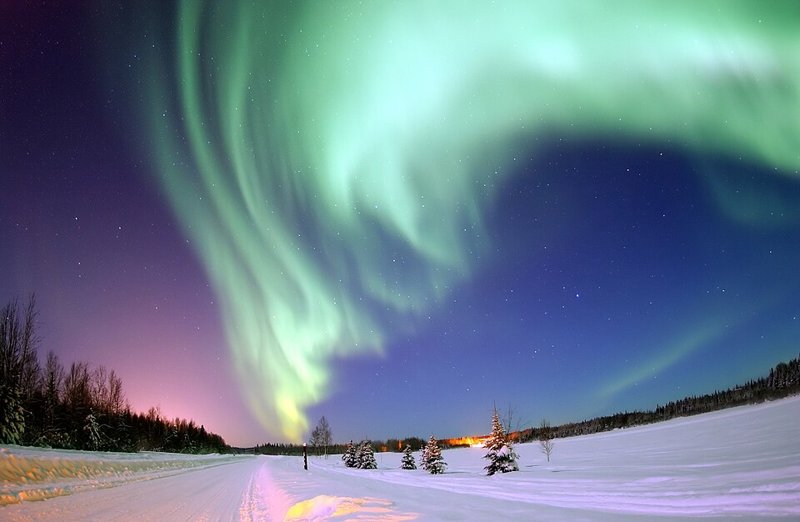
Featured image: Aurora borealis over Eielson Air Force Base, Alaska. U.S. Air Force photo by Senior Airman Joshua Strang, public domain, via Wikimedia Commons.

Sources
- NOAA Space Weather Prediction Center. Tips on viewing the aurora.
- NOAA Space Weather Prediction Center. NOAA space weather scales.
- University of Alaska Fairbanks Geophysical Institute. Aurora forecast and FAQ.
- NASA Science. NASA’s guide to finding and photographing auroras.
- NASA. How can I see the northern lights? We asked a NASA expert.