
Last updated: November 28, 2026
The Quadrantid meteor shower peaks on the night of January 3-4, 2027, with a maximum predicted for 10:25 p.m. EST on January 3 (03:25 UT on January 4). The peak lasts only a few hours, can produce 60 to 200 meteors per hour under ideal skies, and a nearly new Moon keeps skies dark this year.
This guide covers the 2027 dates and peak times by time zone, when the radiant is high enough to watch, where to look and how to see the most meteors, based on NASA and the International Meteor Organization (IMO).
Contents
- When is the Quadrantid meteor shower in 2027?
- What time is the best time to watch?
- Will the Moon affect the Quadrantids?
- Where to look for the Quadrantids
- How to watch the Quadrantid meteor shower
- How many meteors can you see?
- What causes the Quadrantid meteor shower?
- Frequently asked questions
When is the Quadrantid meteor shower in 2027?
The Quadrantids are the first major meteor shower of the year. NASA lists the shower as active from December 28, 2026, to January 12, 2027, with the peak on the night of January 3-4, 2027. The IMO 2027 Meteor Shower Calendar puts the maximum at January 4, 03:25 UT, and notes an uncertainty of about 2.5 hours in the peak timing.
Here is that predicted maximum converted to common time zones:
| Time zone | Predicted peak (IMO, 03:25 UT) |
|---|---|
| Pacific (PST) | 7:25 p.m., Sunday, January 3 |
| Central (CST) | 9:25 p.m., Sunday, January 3 |
| Eastern (EST) | 10:25 p.m., Sunday, January 3 |
| United Kingdom (GMT) | 3:25 a.m., Monday, January 4 |
| Central Europe (CET) | 4:25 a.m., Monday, January 4 |
| India (IST) | 8:55 a.m., Monday, January 4 (daylight) |
The calendar adds that bright fireballs have been seen even a few days after the peak, and that the 5 to 7 days after the maximum remain usable for observing.
What time is the best time to watch the Quadrantids?
The best time balances two factors: the short peak and the height of the radiant, the point the meteors appear to come from. Timeanddate.com notes that the higher the radiant is above the horizon, the more meteors you are likely to see. Its table for Boston on the night of January 3-4, 2027, shows how the radiant climbs through the night:
- 10:00 p.m.: about 4 degrees above the horizon
- Midnight: about 14 degrees
- 2:00 a.m.: about 29 degrees
- 4:00 a.m.: about 47 degrees
- 6:00 a.m.: about 67 degrees, before sunrise at 7:13 a.m.
For eastern North America, the predicted maximum comes while the radiant is still low, so watch from late evening if you can and keep going through the predawn hours. In the United Kingdom and Europe, the maximum falls in the early morning darkness. NASA notes the Quadrantids are best viewed during the night and predawn hours, and that the show lasts until dawn.
Will the Moon affect the Quadrantids?
Not much in 2027. The IMO calendar says the Quadrantid peak comes shortly before New Moon, which falls on January 7, and describes the moonlight conditions as perfect. For Boston, timeanddate.com lists moonrise at 4:51 a.m. on January 4, so the Moon does not rise until the last hours before dawn.
Where to look for the Quadrantids
The shower is named for Quadrans Muralis, a constellation that no longer exists. NASA says it sat between Boötes and Draco, near the end of the handle of the Big Dipper, which is why the shower is also called the Bootids. NASA recommends lying flat on your back with your feet facing northeast and looking up at as much sky as possible.
You do not need to stare at Boötes. Meteors can appear in any part of the sky; the radiant only shows which shower a meteor belongs to. The same approach works for the Geminid meteor shower in December.
How to watch the Quadrantid meteor shower
Timeanddate.com notes that you do not need special equipment or skills to view a meteor shower. These steps combine advice from NASA and timeanddate.com:
- Check the forecast. A clear sky is essential; timeanddate.com says Boston has been cloudy on January 3-4 about 74% of the time since 2000.
- Get away from lights. Choose a spot well away from city and street lights.
- Dress for winter. Bring warm layers and a sleeping bag, blanket or lawn chair.
- Lie back and face northeast. Take in as much of the sky as possible.
- Let your eyes adapt. Timeanddate.com says this takes 15 to 20 minutes, and NASA says you will begin to see meteors in less than 30 minutes in the dark.
- Be patient. Meteor watching can be a waiting game, and NASA notes the show lasts until dawn.
If you are also hoping to spot an aurora this winter, see our guide on how to see the northern lights.
How many meteors can you see?
The IMO lists a zenithal hourly rate (ZHR) of 80 for the Quadrantids, which can vary from about 60 to 200. The IMO defines ZHR as the calculated maximum number of meteors an ideal observer would see per hour in perfectly clear skies with the radiant overhead, so real counts are usually lower. The IMO says recent returns have varied: peak rates in 2022, 2023 and 2025 were in the lower part of that range, while 2024 and 2026 were close to average.
The IMO also notes that the stream is slightly shifted toward the Sun in 2027, which might cause enhanced activity. The meteors enter the atmosphere at about 41 kilometers (25 miles) per second, and NASA notes the shower is known for bright fireballs, brighter than magnitude -3, that can last longer than an average meteor streak.
What causes the Quadrantid meteor shower?
Most meteor showers come from comets, but NASA says the Quadrantids come from asteroid 2003 EH1, which may be a “dead comet” or “rock comet.” It is only about 2 miles (3 kilometers) across and takes 5.52 years to orbit the Sun. Astronomer Peter Jenniskens identified it as the shower’s source.
Each January, Earth passes through the trail of dust and debris left along the asteroid’s orbit, and the particles burn up as streaks of light. The constellation Quadrans Muralis was created by French astronomer Jerome Lalande in 1795, the meteors were first seen in 1825, and the International Astronomical Union left the constellation off its official list in 1922. For more winter sky events, read about the winter solstice and how snowflakes form.
Frequently asked questions
When is the Quadrantid meteor shower in 2027?
The Quadrantids are active from December 28, 2026, to January 12, 2027, and peak on the night of January 3-4, 2027. The International Meteor Organization predicts the maximum for January 4 at 03:25 UT, which is 10:25 p.m. EST on January 3.
Where do you look for the Quadrantid meteor shower?
Face northeast and take in as much of the sky as you can. The meteors appear to come from a point in the constellation Boötes, near the end of the Big Dipper’s handle, but they can appear anywhere in the sky.
How many meteors per hour can you see during the Quadrantids?
Under perfect conditions, 60 to as many as 200 Quadrantid meteors can be seen per hour at the peak, according to NASA. Most observers see fewer, because the peak lasts only a few hours and the count drops with city lights and when the radiant is low in the sky.
Why is the Quadrantid peak so short?
NASA explains that the shower’s stream of particles is thin and Earth crosses it at a perpendicular angle. As a result, the peak lasts only a few hours instead of the roughly two days typical of other major showers.
Can you see the Quadrantids from the Southern Hemisphere?
The Quadrantids are best viewed from the Northern Hemisphere. NASA says the shower can also be seen from latitudes north of 51 degrees south.
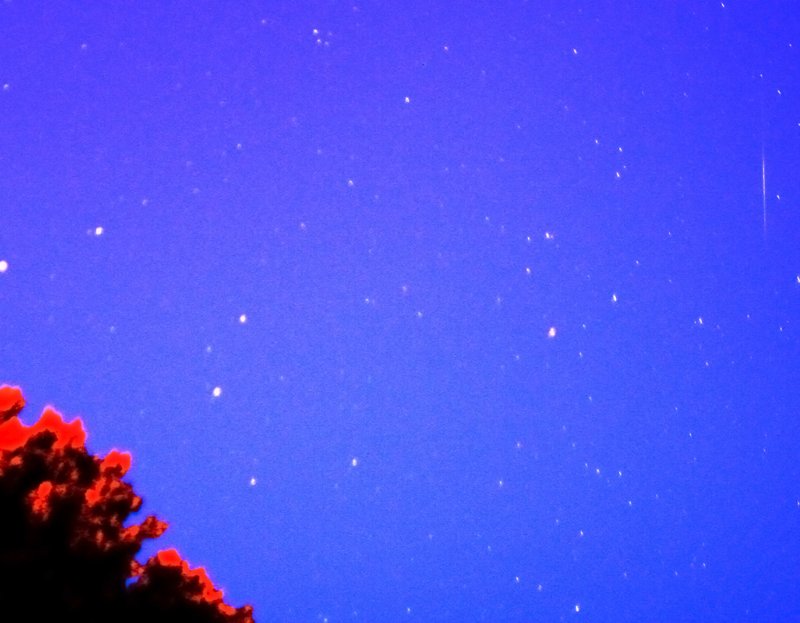
Featured image: “QUADRANTID meteor on January 3 2009” by Brocken Inaglory, via Wikimedia Commons, licensed under CC BY-SA 3.0; resized.

Sources
- NASA Science: Quadrantids
- International Meteor Organization: 2027 Meteor Shower Calendar (PDF)
- Timeanddate.com: Quadrantids Meteor Shower 2027