
Last updated: November 27, 2026
The standard deduction for 2026 is $16,100 for single filers and married people filing separately, $32,200 for married couples filing jointly and $24,150 for heads of household. It is a flat amount that reduces the income you pay federal tax on, and it applies to 2026 returns filed in 2027.
Taxpayers who are 65 or older or blind get an extra amount, and people claimed as dependents get a smaller one. This guide lists the 2026 amounts from IRS Revenue Procedure 2025-32, compares them with 2025 and 2027 and explains when to itemize.
Contents
- What is the standard deduction?
- Standard deduction 2026 amounts by filing status
- Standard deduction 2026 for seniors over 65 and blind taxpayers
- Standard deduction for dependents
- How to figure your standard deduction: examples
- Standard deduction vs. itemized deductions
- Who cannot take the standard deduction?
- Frequently asked questions
What is the standard deduction?
The IRS defines the standard deduction as “a specific dollar amount that reduces the amount of income on which you’re taxed” (IRS Topic No. 551). It has two parts:
- The basic standard deduction, which depends on your filing status.
- Additional amounts for taxpayers who are 65 or older or blind.
The deduction lowers taxable income, not the tax bill directly. If you are not sure how adjusted gross income differs from your paycheck amount, see our explanation of the difference between gross and net income.
Standard deduction 2026 amounts by filing status
The 2025 amounts were raised by the 2025 tax law the IRS now calls the Working Families Tax Cuts, which also made the higher deduction permanent (Rev. Proc. 2025-32). The 2026 and 2027 amounts are those amounts adjusted for inflation.
| Filing status | Tax year 2025 (filed in 2026) | Tax year 2026 (filed in 2027) | Tax year 2027 (filed in 2028) |
|---|---|---|---|
| Single | $15,750 | $16,100 | $16,600 |
| Married filing separately | $15,750 | $16,100 | $16,600 |
| Married filing jointly and surviving spouses | $31,500 | $32,200 | $33,200 |
| Head of household | $23,625 | $24,150 | $24,925 |
Sources: Rev. Proc. 2025-32 for 2025 and 2026, and IRS news release IR-2026-133 (November 5, 2026) for 2027.
Which year’s amount do you use?
Use the amount for the tax year, not the year you file. A return filed in early 2027 covers 2026, and the 2027 amounts first apply to returns filed in 2028.
Standard deduction 2026 for seniors over 65 and blind taxpayers
For 2026, the additional standard deduction for age or blindness is $1,650 per qualifying condition, or $2,050 if you are unmarried and not a surviving spouse (Rev. Proc. 2025-32). For 2027 it rises to $1,700 and $2,100 (Rev. Proc. 2026-35).
- Age: you count as 65 if you are 65 at the end of the tax year. The IRS treats you as 65 on the day before your 65th birthday (Topic No. 551).
- Blindness: you must be blind on the last day of the tax year.
- Both: a person who is 65 or older and blind gets the additional amount twice.
The separate $6,000 senior deduction
For tax years 2025 through 2028, people 65 or older may also claim a $6,000 deduction, or $12,000 for a married couple when both qualify (IRS). It is in addition to the standard deduction, and itemizers can claim it too. Key rules:
- It phases out when modified adjusted gross income exceeds $75,000 ($150,000 for joint filers).
- You need a valid Social Security number, and married couples must file jointly.
- It is claimed on Schedule 1-A (Form 1040).
Standard deduction for dependents
If another taxpayer can claim you as a dependent, your 2026 standard deduction is limited to the greater of $1,350 or your earned income plus $450. It cannot exceed the basic standard deduction for your filing status (Rev. Proc. 2025-32). For 2027 the figures are $1,400 and earned income plus $500 (Rev. Proc. 2026-35). Our guide on how to read a W-2 box by box shows where to find wages for this calculation.
How to figure your standard deduction: examples
Follow these steps:
- Find the basic amount for your filing status in the table above.
- Add $1,650 for each spouse who is 65 or older and for each spouse who is blind, or $2,050 per condition if you are single or head of household.
- If someone can claim you as a dependent, apply the dependent limit instead of step 1.
- Check whether you also qualify for the separate $6,000 senior deduction.
Worked examples for tax year 2026:
| Taxpayer | Calculation | 2026 standard deduction |
|---|---|---|
| Single, age 30 | $16,100 | $16,100 |
| Single, age 67 | $16,100 + $2,050 | $18,150 |
| Single, age 67 and blind | $16,100 + $2,050 + $2,050 | $20,200 |
| Married filing jointly, both 66 | $32,200 + $1,650 + $1,650 | $35,500 |
| Head of household, age 65 | $24,150 + $2,050 | $26,200 |
| Dependent student with $3,000 of wages | Greater of $1,350 or $3,000 + $450 | $3,450 |
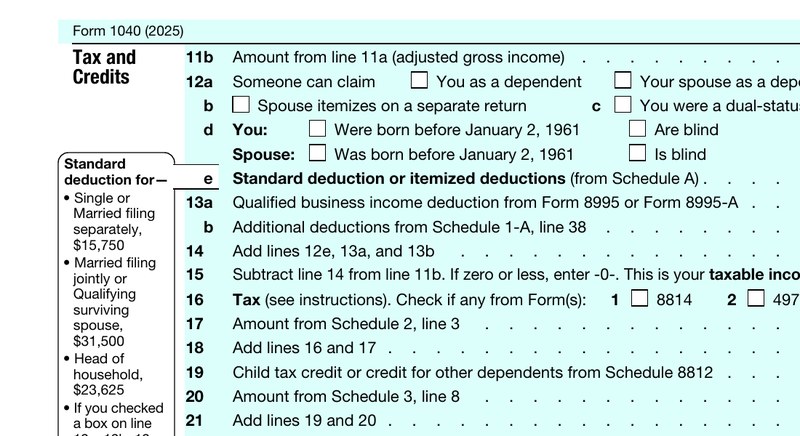
If the married couple’s modified adjusted gross income is $150,000 or less, they can also claim the $12,000 senior deduction, for $47,500 in total. On the 2025 Form 1040, the standard deduction goes on line 12e and Schedule 1-A deductions on line 13b. For other everyday tax math, see how to calculate percentages.
Standard deduction vs. itemized deductions
You choose one or the other. The IRS says you should itemize on Schedule A if your allowable itemized deductions are greater than your standard deduction, or if you cannot use the standard deduction (IRS Topic No. 501). Itemized deductions, subject to dollar limits, may include:
- State and local income or sales taxes, real property taxes and personal property taxes
- Home mortgage interest
- Gifts to charity
- Medical and dental expenses
- Disaster losses and certain gambling losses
Keep receipts during the year so you can compare totals at filing time; our guide on how to make a budget covers simple tracking methods. Self-employed business expenses are a separate matter, explained in W-2 vs. 1099 worker taxes.
Who cannot take the standard deduction?
According to IRS Topic No. 551, you cannot take the standard deduction if:
- You are married filing separately and your spouse itemizes.
- You were a nonresident alien or dual-status alien during the year, with limited exceptions.
- You file a return for less than 12 months because your annual accounting period changed.
- You are filing for an estate, trust, common trust fund or partnership.
Frequently asked questions
What is the standard deduction for 2026?
For tax year 2026, the standard deduction is $16,100 for single filers and married couples filing separately, $32,200 for married couples filing jointly and surviving spouses, and $24,150 for heads of household. These amounts apply to returns filed in 2027.
What is the standard deduction for seniors over 65 in 2026?
A taxpayer 65 or older adds $1,650 to the basic standard deduction, or $2,050 if unmarried and not a surviving spouse. A single filer 65 or older therefore gets $18,150, and a married couple filing jointly with both spouses 65 or older gets $35,500.
Is the $6,000 senior deduction part of the standard deduction?
No. The $6,000 senior deduction is a separate deduction for tax years 2025 through 2028, claimed on Schedule 1-A. It is added on top of the standard deduction, is also available to people who itemize and phases out above $75,000 of modified adjusted gross income ($150,000 for joint filers).
Is it better to take the standard deduction or itemize?
Take whichever is larger. The IRS says you should itemize if your allowable itemized deductions are greater than your standard deduction, or if you cannot use the standard deduction.
What is the standard deduction for a dependent in 2026?
If someone else can claim you as a dependent, your 2026 standard deduction is limited to the greater of $1,350 or your earned income plus $450, but not more than the basic standard deduction for your filing status.
Featured image: 2025 Form 1040 (detail), Internal Revenue Service, public domain U.S. government work, via IRS.gov; cropped. This guide is general information, not individual tax advice.
Sources
- IRS: Revenue Procedure 2025-32, tax year 2026 inflation adjustments (PDF)
- IRS: IR-2026-133, tax inflation adjustments for tax year 2027, with Revenue Procedure 2026-35 (PDF)
- IRS: Topic No. 551, Standard deduction
- IRS: Topic No. 501, Should I itemize?
- IRS: Working Families Tax Cuts, individuals and workers