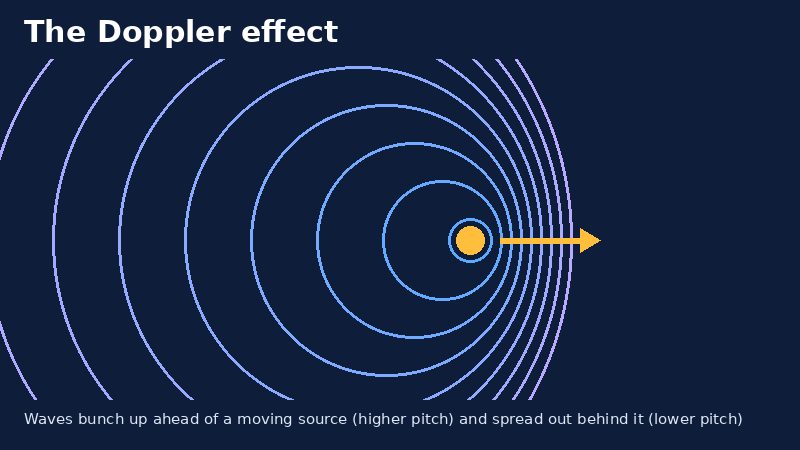
The Doppler effect is the apparent change in the frequency of a sound or light wave caused by relative motion between the wave source and the observer. When the source and observer move toward each other, the waves arrive bunched together, so the pitch sounds higher (or light shifts toward blue); when they move apart, the waves spread out, so the pitch drops (or light shifts toward red). That is why a passing siren or horn sounds higher as it approaches and lower after it passes.
Austrian physicist Christian Doppler first described the effect in 1842. Today it is used in radar and navigation, and astronomers use it to measure how stars and galaxies are moving relative to Earth.